poetry

Explanation
The Joke
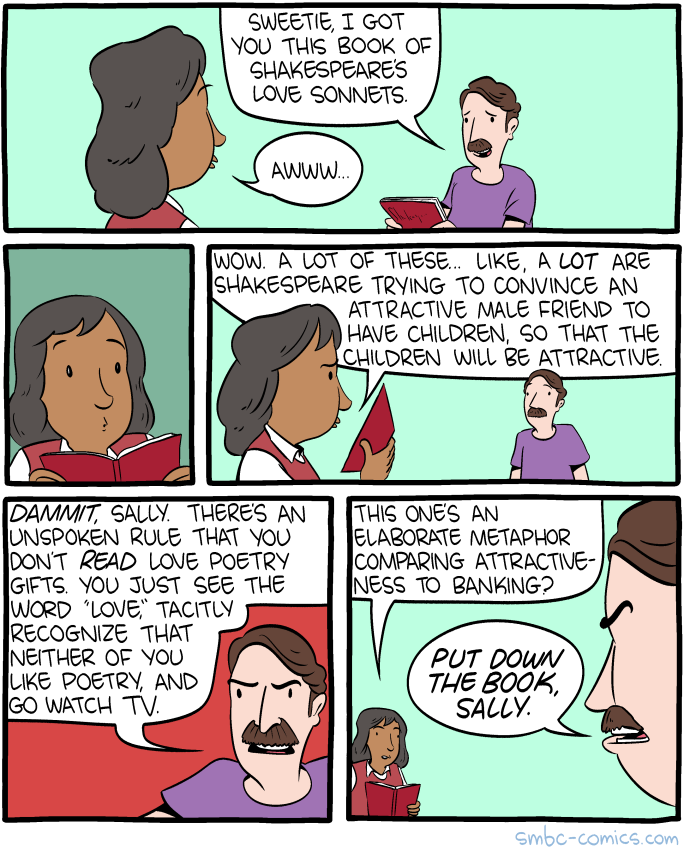
A man gives a woman a gift: "Sweetie, I got you this book of Shakespearean love sonnets!" She responds enthusiastically: "Awww!" But then a third person interjects with an uncomfortable observation: "Don't you think it's a lot like Shakespearean trying to seduce an attractive male friend to let him impregnate the friend's wife, so that the friend's children will be attractive?" The woman looks disturbed by this reframing.
In the final panel, another person piles on: "Dammit Sally, there's an enormous metaphor just below the surface, and if you just read the poetry and recognize that some of it is disturbing, like poetry and banking..." Someone else responds: "Put down the book, Sally." The comic exposes the uncomfortable reality behind Shakespeare's famous sonnets. Many of Shakespeare's early sonnets (the "Fair Youth" sonnets, 1-126) are addressed to a young man and urge him to marry and have children so his beauty will be preserved. Read literally, they involve a much older poet obsessively fixated on a young man's physical beauty and reproductive choices, which sounds far less romantic when stripped of the poetic language.
The Humor
The humor comes from the collision between how we culturally receive Shakespeare's sonnets -- as the gold standard of romantic literature, suitable for gifting to a loved one -- and what they actually say when read without the protective haze of "it's classic literature." The comic plays on the gap between the reverence we give to canonical poetry and the sometimes uncomfortable content hiding behind beautiful language. The title text ("That banking poem is a real thing, by the way. I'm not quite sure how these are so popular") refers to Shakespeare's frequent use of financial and mercantile metaphors for love and beauty, reinforcing the idea that these poems are stranger than their cultural reputation suggests.
References
Shakespeare's Sonnets, particularly the first 17 (known as the "Procreation Sonnets"), urge a young man -- traditionally identified as the "Fair Youth" -- to marry and have children. Sonnet 1 opens with "From fairest creatures we desire increase," explicitly framing beauty as something that should be biologically reproduced. The identity of the Fair Youth remains debated, with candidates including Henry Wriothesley, 3rd Earl of Southampton, and William Herbert, 3rd Earl of Pembroke.