potential

Explanation
The Joke
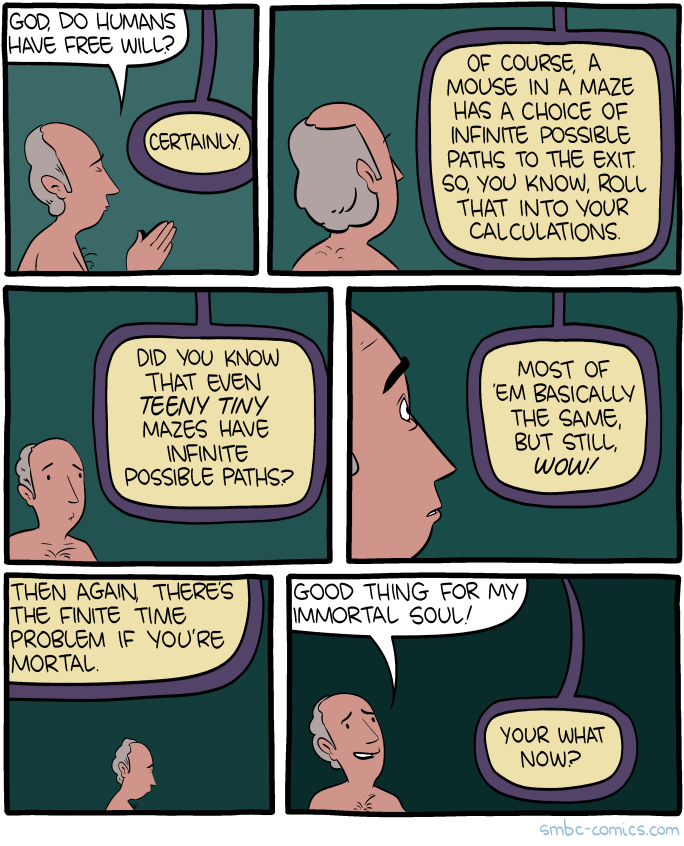
A person prays to God, asking whether humans have free will. God responds "Certainly," but then qualifies it with an analogy: a mouse in a maze has a choice of infinite possible paths to the exit. God further notes that even teeny tiny mazes have infinite possible paths, though most of them are "basically the same." This is God redefining "free will" in the most technically-true-but-practically-useless way possible -- sure, you have infinite choices, but they are all essentially the same.
God then adds a caveat: "Then again, there's the finite time problem if you're mortal." The person cheerfully responds, "Good thing for my immortal soul!" to which God replies, "Your what now?" The final twist reveals that God apparently has no idea what an "immortal soul" is, suggesting that either souls do not exist in this theology, or God has forgotten about that feature entirely.
The Humor
The comic layers multiple jokes about theology and philosophy. The free will argument is a parody of how technical definitions can render a grand concept meaningless -- having "infinite paths" sounds impressive until you learn they are all basically identical. The punchline undercuts the entire conversation by having God be unaware of the concept of an immortal soul, which is the foundational belief of most religions that also posit the existence of God. The person has been having a theological conversation with a deity who does not even offer the afterlife the person assumed was part of the package.
References
The comic touches on the philosophical debate about free will and determinism. The maze analogy loosely references the concept of "degrees of freedom" in physics and mathematics, where a system may technically have many possible states but be constrained in practice. The "infinite paths" argument is reminiscent of compatibilist positions on free will, which argue that free will is compatible with determinism by redefining what "free" means in a way critics find unsatisfying.