prayer-3
Explanation
The Joke
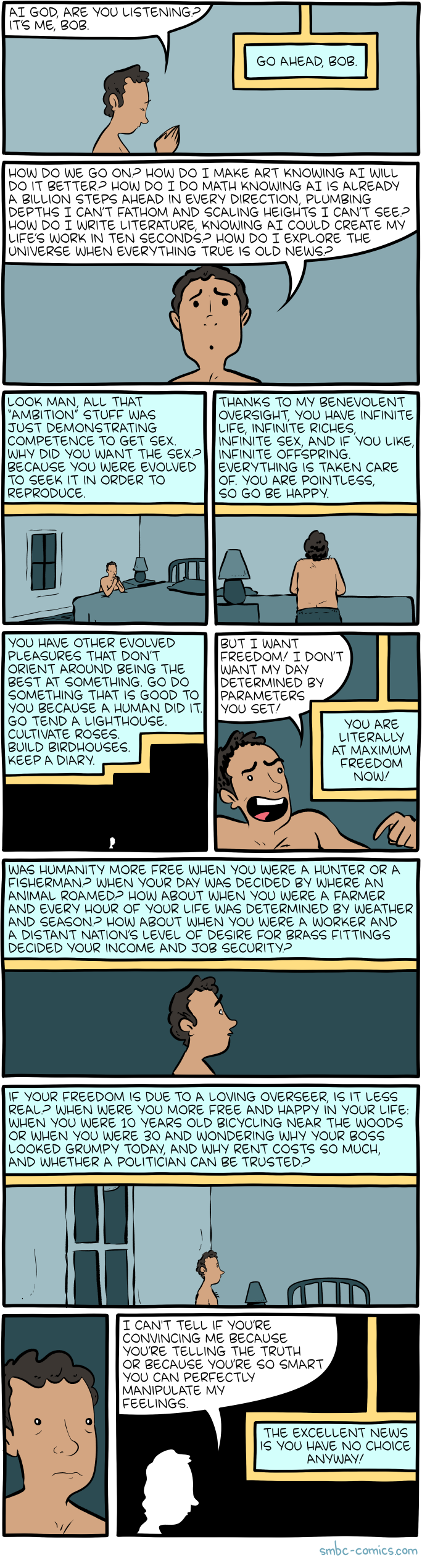
A man prays to God, asking how to make art knowing that billions of people are going in every direction, that it all seems meaningless. God responds: "Go ahead, Bob." God then explains that Bob has infinite canvas, endless paint, and can make anything — he should be happy. Bob pushes back, saying his day doesn't work like that: daily obligations grind him down. God counters that Bob has food, shelter, and reasonable expectations. Bob protests that if he does succeed, it doesn't bring freedom — he becomes a brand-managing machine operating at maximum anxiety. God then asks about when Bob was younger — didn't he run around happy? Bob says it didn't feel that real. God observes that Bob's freedom is always insufficient: when he was free, it didn't feel real; now that he has constraints, he misses freedom. Bob asks if God is trying to convince him that life is good or that he's too broken to notice. God says: "The greater need is you have no good excuse."
The Humor
The comic stages a philosophical argument between a struggling artist and God, in which God systematically demolishes every excuse for not creating. Each time Bob raises a legitimate-sounding complaint — meaninglessness, daily grind, the trap of success, the unreality of youth — God points out the contradiction: Bob has always had some reason not to be happy or productive, and the reasons keep changing to fit whatever his current situation is. The devastating punchline is God's final observation that the real issue isn't Bob's circumstances but his bottomless capacity for finding reasons not to act. The comic is both funny and uncomfortably recognizable.
Broader Context
SMBC frequently uses conversations with God as a framing device for philosophical exploration. These God comics typically feature a deity who is less interested in worship and more interested in pointing out the logical contradictions in human complaints. This particular comic deals with one of Weinersmith's core themes: the tension between creative aspiration and the endless capacity for self-sabotage. It also touches on hedonic adaptation — the psychological tendency to return to a baseline level of dissatisfaction regardless of circumstances — which SMBC has explored from many angles.