Prediction

Explanation
The Joke
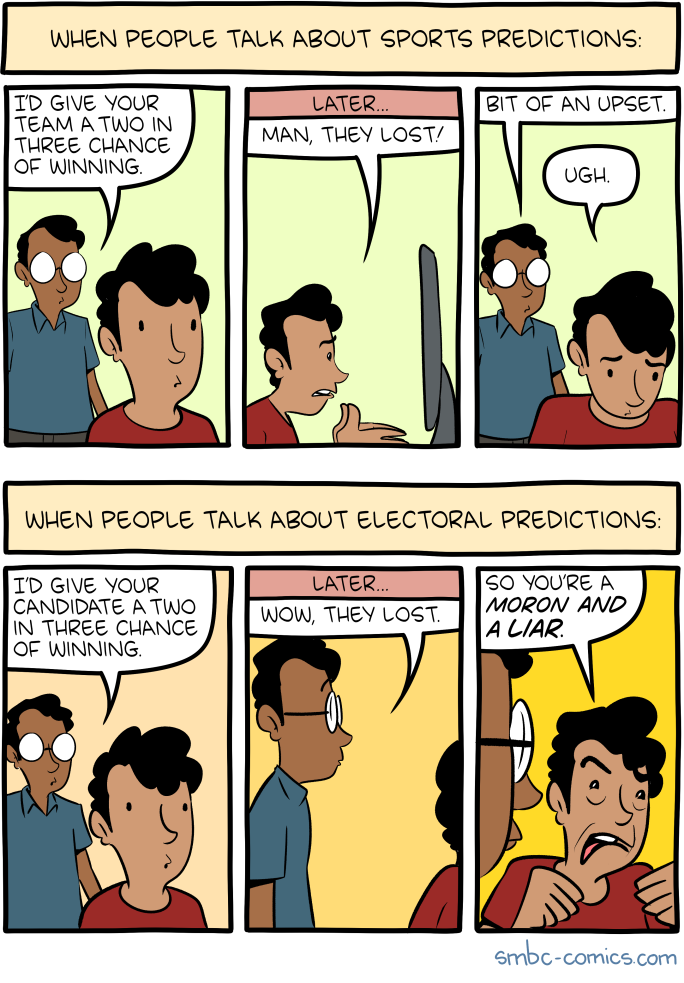
The comic contrasts how people react to predictions about sports versus predictions about elections. In the top half, labeled "When people talk about sports predictions," someone says "I'd give your team a two in three chance of winning." Later, when the team loses, the predictor shrugs and says it was an upset -- and the other person accepts this calmly with just a disappointed "Ugh."
In the bottom half, labeled "When people talk about electoral predictions," the same scenario plays out: "I'd give your candidate a two in three chance of winning." When the candidate loses, the reaction is completely different -- instead of accepting statistical reality, the person angrily declares "So you're a moron and a liar!" The predictor is left speechless.
The Humor
The comic highlights a deeply irrational double standard in how people interpret probabilistic forecasts. A two-in-three chance means there is still a one-in-three chance of the opposite outcome -- in either context. Sports fans generally understand this intuitively and accept that upsets happen. But when it comes to elections, people treat a probabilistic prediction as if it were a guarantee, and when the less likely outcome occurs, they blame the forecaster rather than acknowledging that a 33% event simply came to pass. The joke is a pointed commentary on the emotional investment people place in political outcomes compared to sports, and how that emotion completely overrides their ability to reason about probability.
References
This comic almost certainly references the 2016 U.S. presidential election, in which many forecasters (most notably Nate Silver's FiveThirtyEight) gave Hillary Clinton roughly a two-in-three chance of winning. When Donald Trump won, many people accused the forecasters of being wrong or biased, despite the fact that the models had consistently given Trump a substantial (roughly one-in-three) chance -- similar to the probability of rolling a 1 or 2 on a standard die.