preference

Explanation
The Joke
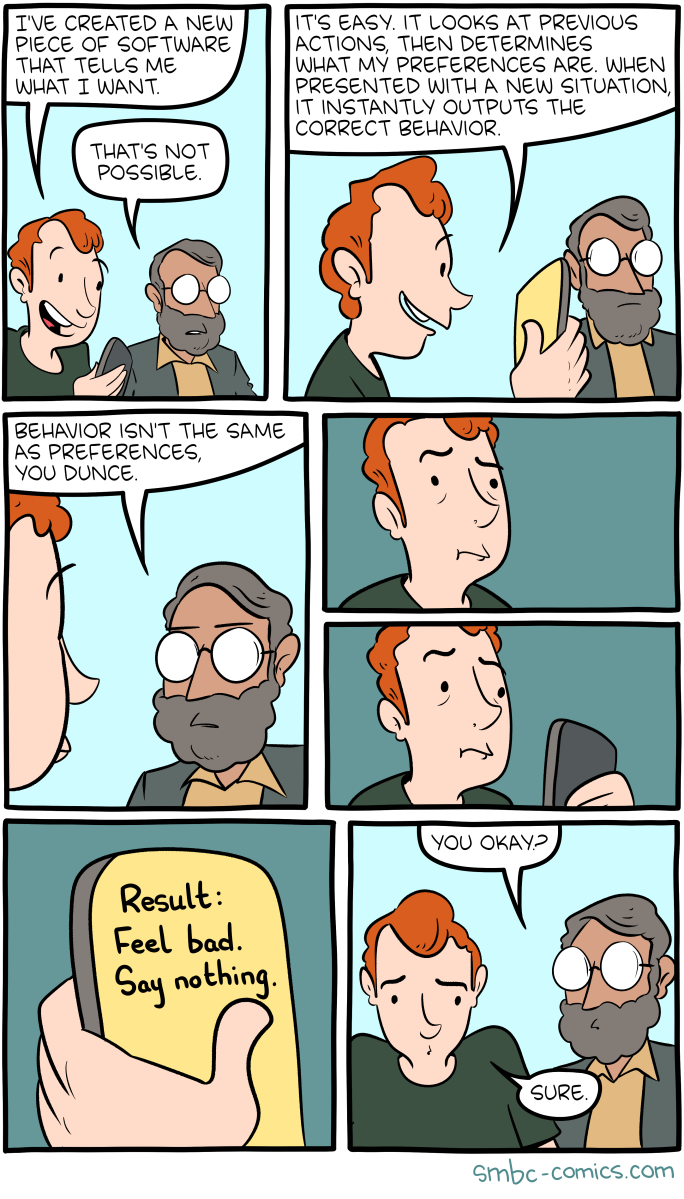
The comic features a character who has created a new piece of software that tells him what he wants. He explains that it works by looking at his previous actions, then determining what his preferences are, so that when presented with a new situation it tells him the correct behavior. His friend objects, saying "That's not how preference works," but the creator dismisses him. The software is then labeled as "Bayesian inference applied to preferences, you dunce."
However, the punchline comes in the final panels. When the software actually produces its output, the result reads: "Result: Feel bad. Say nothing." The creator looks at it and says "You can't..." trailing off in dismay. The software, having accurately analyzed his past behavior patterns, has correctly determined that his actual revealed preference in most situations is to feel bad and say nothing -- a brutally honest assessment that he clearly did not want to hear.
The Humor
The comic satirizes the gap between what people think their preferences are and what their actual behavior reveals. The idea of using Bayesian inference to determine preferences from past actions is a real concept in economics and decision theory ("revealed preferences"), but the joke is that if you honestly applied this to most people, the algorithm would discover that their most consistent behavior pattern is passive suffering and avoidance. The creator built a tool expecting it to optimize his life, only to have it hold up an unflattering mirror. The friend's early objection that "that's not how preference works" adds another layer -- perhaps he was trying to warn that you would not like what you find.
References
Bayesian inference is a statistical method that updates the probability of a hypothesis as more evidence becomes available. Revealed preference theory, developed by economist Paul Samuelson, holds that consumers' preferences can be inferred from their purchasing (or behavioral) choices rather than from what they say they prefer.