prime-factors
Explanation
The Joke
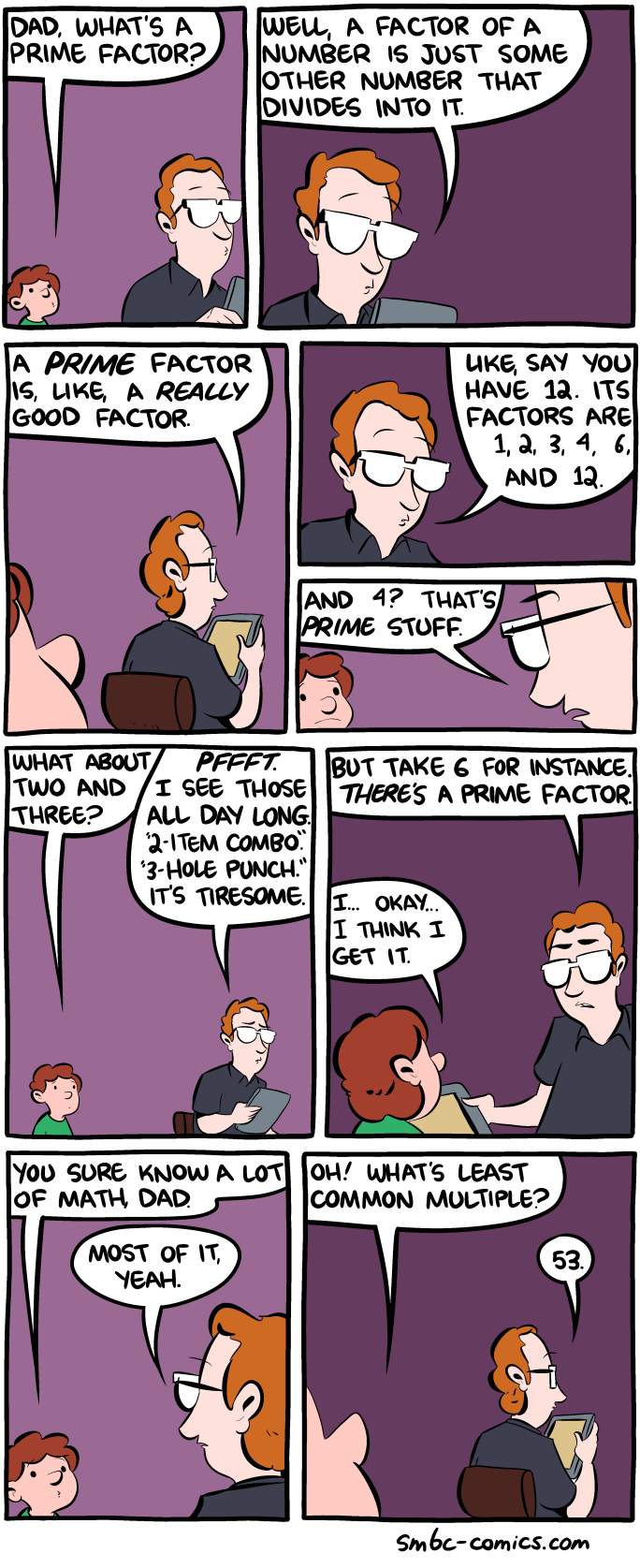
A child asks her dad, "What's a prime factor?" The dad explains that a factor of a number is a number that divides into it, and gives the example that 12 has factors 1, 2, 3, 4, 6, and 12. He explains that a prime factor is "like a really good factor" and notes that while 4 and 6 are factors of 12, they are not prime, but 2 and 3 are prime factors. The daughter then asks what "least common multiple" means, and the dad hesitates and deflects. The daughter observes, "You sure know a lot of math, Dad," and he sheepishly admits "Most of it. Yeah."
The Humor
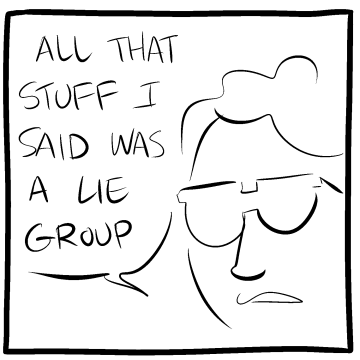
The comedy comes from the dad's confident-sounding but somewhat shaky math explanations. He does a decent job of explaining factors and prime factors, clearly drawing on half-remembered knowledge. But when the daughter asks about "least common multiple" — a concept that is only slightly more advanced — the dad immediately hits the limit of his knowledge and tries to change the subject. His claim to know "most" of math is humorously self-aggrandizing, since he has been stumped by elementary school arithmetic. This is a relatable scenario for many parents who find themselves struggling to help with their children's homework, even at the most basic levels, and who bluff their way through to maintain an air of authority.