priming
Explanation
The Joke
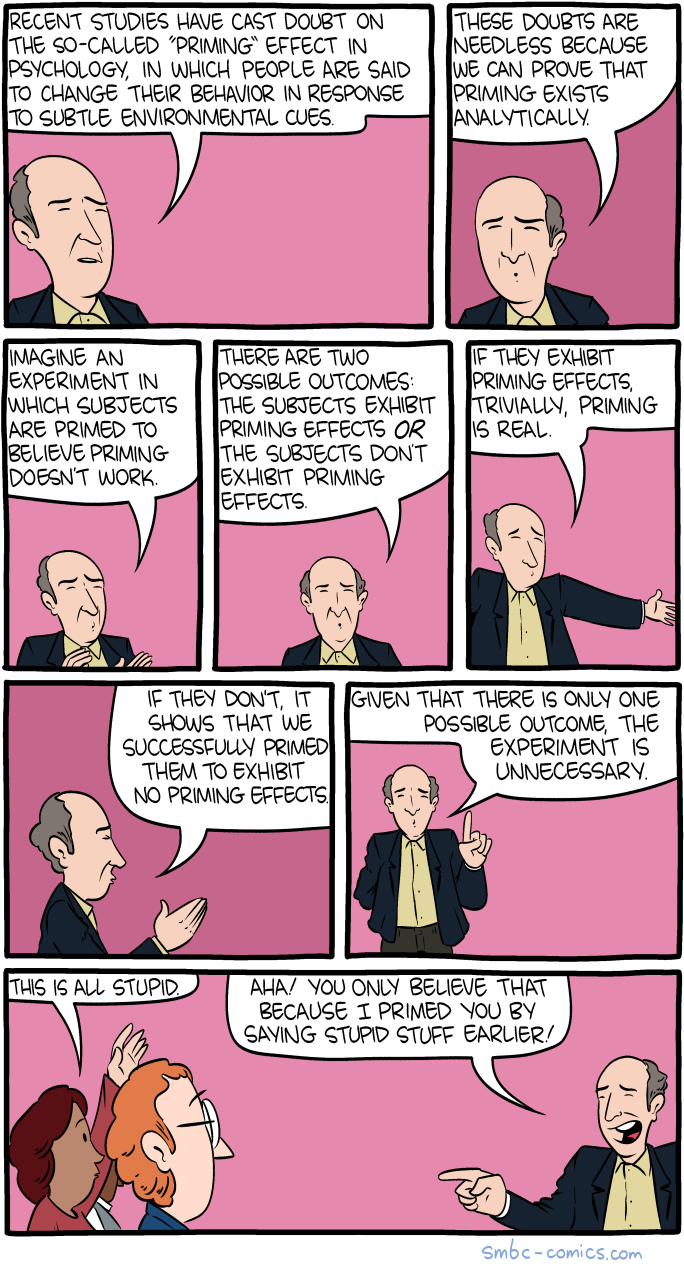
The comic addresses the replication crisis in psychology, specifically the controversy around "priming effects." The first panel explains that recent studies have cast doubt on so-called priming effects in psychology, in which people were said to change their behavior in response to subtle environmental cues. The comic then lays out a logical trap: imagine an experiment in which subjects are either primed to believe priming effects are real, or primed to believe priming effects are fake.
There are four possible outcomes: the subjects exhibit priming effects (confirming priming works), the subjects don't exhibit priming effects (suggesting priming is fake), priming believers show effects while skeptics don't (a paradox), or neither group shows effects. The comic points out that if there is even one group that was successfully primed to doubt priming, then priming effects must be real -- because you successfully primed them. The final panel has a character saying "You only believe that because you read that dumb study earlier!" -- itself a demonstration of priming.
The Humor
The joke is a delicious logical paradox. If you can prime someone into not believing in priming, then priming works -- which means the person was wrong to disbelieve in it. And if you cannot prime them, then priming doesn't work, which validates their skepticism but for the wrong reason. The comic turns the replication crisis debate into a self-referential loop, and the final panel adds an extra layer by suggesting that the reader's own reaction to the comic might itself be a priming effect. It is a clever piece of philosophical humor that makes the reader question whether their assessment of the argument was independently arrived at or itself primed.
References
The "replication crisis" refers to the finding that many results in psychology (and other fields) cannot be reproduced when experiments are repeated. Priming effects, especially "social priming" (e.g., the famous study claiming that reading words associated with old age made people walk more slowly), have been among the most prominent casualties of replication attempts.