problem

Explanation
The Joke
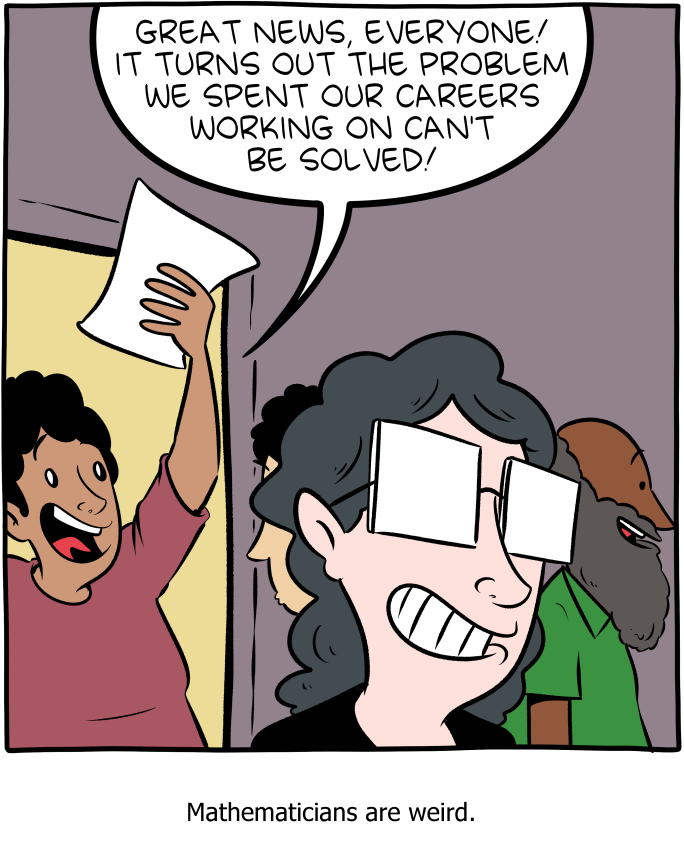
A mathematician bursts through a door shouting "Great news, everyone! It turns out the problem we spent our careers working on can't be solved!" The other mathematicians in the room appear equally delighted. The caption reads: "Mathematicians are weird."
The joke captures a genuine quirk of mathematical culture: proving that a problem is unsolvable is itself considered a major achievement, sometimes even more prestigious than solving it. For a mathematician, discovering that a problem is undecidable or that no solution exists is not a failure -- it is a definitive result that closes a question and advances human knowledge.
The Humor
The humor comes from the contrast between how a normal person would react to learning their life's work was futile (devastation) and how mathematicians react (celebration). To a non-mathematician, "the problem can't be solved" sounds like the worst possible news. But in mathematics, an impossibility proof is a legitimate and often celebrated result. The comic plays on this cultural disconnect, with the caption "Mathematicians are weird" serving as an understated acknowledgment that this profession's value system is fundamentally alien to most people.
References
- Famous impossibility results in mathematics include the proof that you cannot trisect an arbitrary angle with compass and straightedge, the proof that the halting problem is undecidable (Alan Turing, 1936), and Goedel's incompleteness theorems (1931), which showed that any sufficiently powerful formal system contains statements that cannot be proved or disproved within the system. All of these are considered landmark achievements.