prodigy
Explanation
The Joke
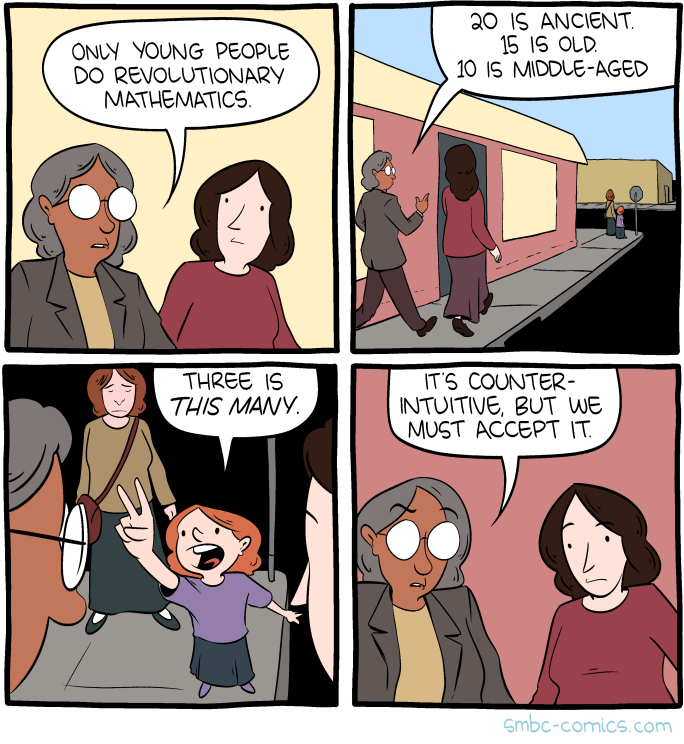
A woman states the common observation that "Only young people do revolutionary mathematics." Another character then provides the age context: "20 is ancient. 15 is old. 10 is middle-aged." The punchline shows a very young child standing in front of a school bus, with someone saying "There is this many" (holding up fingers) while another character responds "It's counter-intuitive, but we must accept it."
The comic takes the well-known truism in mathematics that groundbreaking work is disproportionately done by young people (the stereotype that mathematicians peak in their 20s) and pushes it to an absurd extreme. If younger is always better for mathematical genius, then the logical endpoint is that toddlers and small children should be the greatest mathematicians -- except a toddler's understanding of math is literally "this many" (counting on fingers).
The Humor
The humor works by taking a real pattern (young mathematicians producing revolutionary work) and extending it past its breaking point through reductio ad absurdum. The joke highlights the silliness of over-generalizing the "youth equals brilliance" narrative: yes, many great mathematical discoveries were made by people in their 20s and 30s, but the trend obviously does not continue downward to early childhood. The child proudly declaring "there is this many" while the adults solemnly accept this as counter-intuitive genius is a perfect absurdist image. The phrase "It's counter-intuitive, but we must accept it" parodies the language of scientific deference to data, even when the "data" is a small child counting on their fingers.
References
The idea that mathematics is a young person's game is widely attributed to G.H. Hardy, who wrote in "A Mathematician's Apology" (1940) that "No substantial contribution to mathematics has been made by any man over fifty." While there is some statistical support for the notion that breakthrough mathematical work tends to happen earlier in a career, it is far from an absolute rule, and many mathematicians have made significant contributions later in life.