profits-and-process
Explanation
The Joke
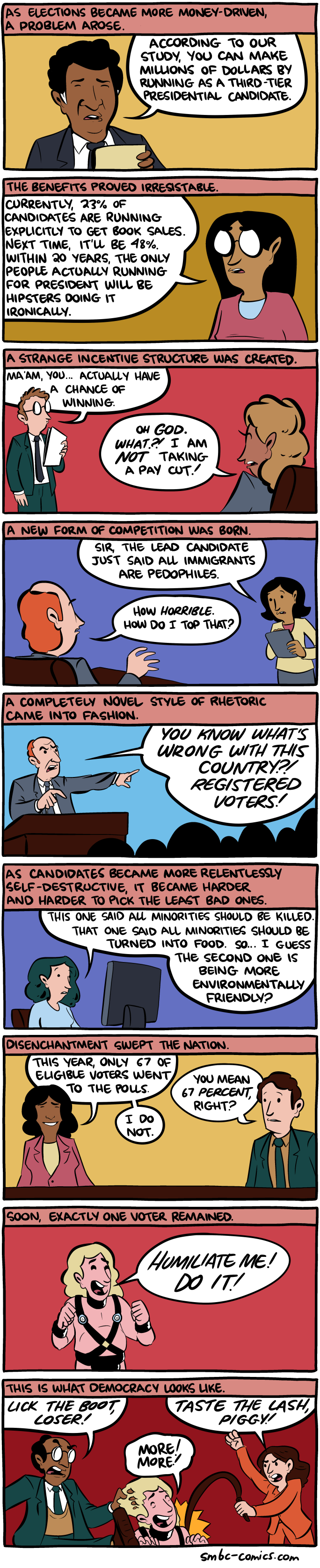
This long-form comic traces a dystopian progression of what happens when running for president becomes more profitable than actually governing. It follows several escalating stages:
- Elections become money-driven: A study reveals you can make millions just by running as a third-tier presidential candidate.
- The incentive becomes irresistible: 27% of candidates are running purely to sell books, and within 20 years the only people running for president will be those hoping to profit from it ironically.
- A strange incentive structure emerges: A woman who actually wanted to make change finds herself winning, and panics -- "Oh God, what? I am NOT taking a pay cut."
- Competition heats up: Candidates begin making increasingly outrageous statements (like "all immigrants are pedophiles") just to grab attention and stay relevant for profit.
- Rhetoric becomes fashion: Politicians yell things like "You know what's wrong with this country? Registered voters!" -- openly attacking the democratic process itself.
- Self-destruction escalates: Candidates compete to be the worst, proposing that all minorities should be killed or turned into food, while trying to one-up each other.
- Voter turnout collapses: Only 67% (then fewer and fewer) of eligible voters show up, until eventually exactly one voter remains.
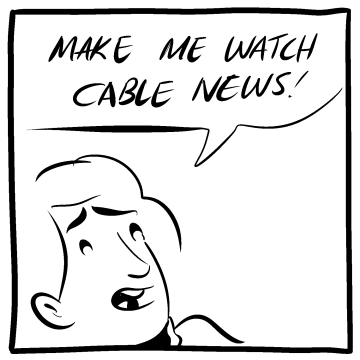
- The final scene: The last remaining voter is in a BDSM-style relationship with the politicians, who humiliate and degrade her while she begs for more, with the caption: "This is what democracy looks like."
The Humor
The comic is a satirical extrapolation of the perverse incentives in American politics, particularly the phenomenon of candidates running for president primarily to boost their personal brand, sell books, and secure media deals. Weinersmith takes this real trend and pushes it to its logical extreme: if the profit motive completely overtakes the governing motive, democracy devolves into a spectacle where politicians compete to be the most outrageous, voters become increasingly disengaged, and the entire system collapses into a grotesque performance. The final panel -- depicting the last voter in a dominatrix-like scenario with politicians -- is a darkly comedic metaphor for the masochistic relationship between an abused electorate and a political class that openly contempts them.
References
- The comic alludes to the real phenomenon of vanity presidential campaigns in the United States, where candidates run primarily for book deals, speaking fees, and media exposure rather than with a genuine expectation of winning.
- "Silent majority" and voter apathy are recurring themes in American political discourse.
- The final panel's phrase "This is what democracy looks like" is a parody of the protest chant commonly used at political demonstrations.