protagonist

Explanation
The Joke
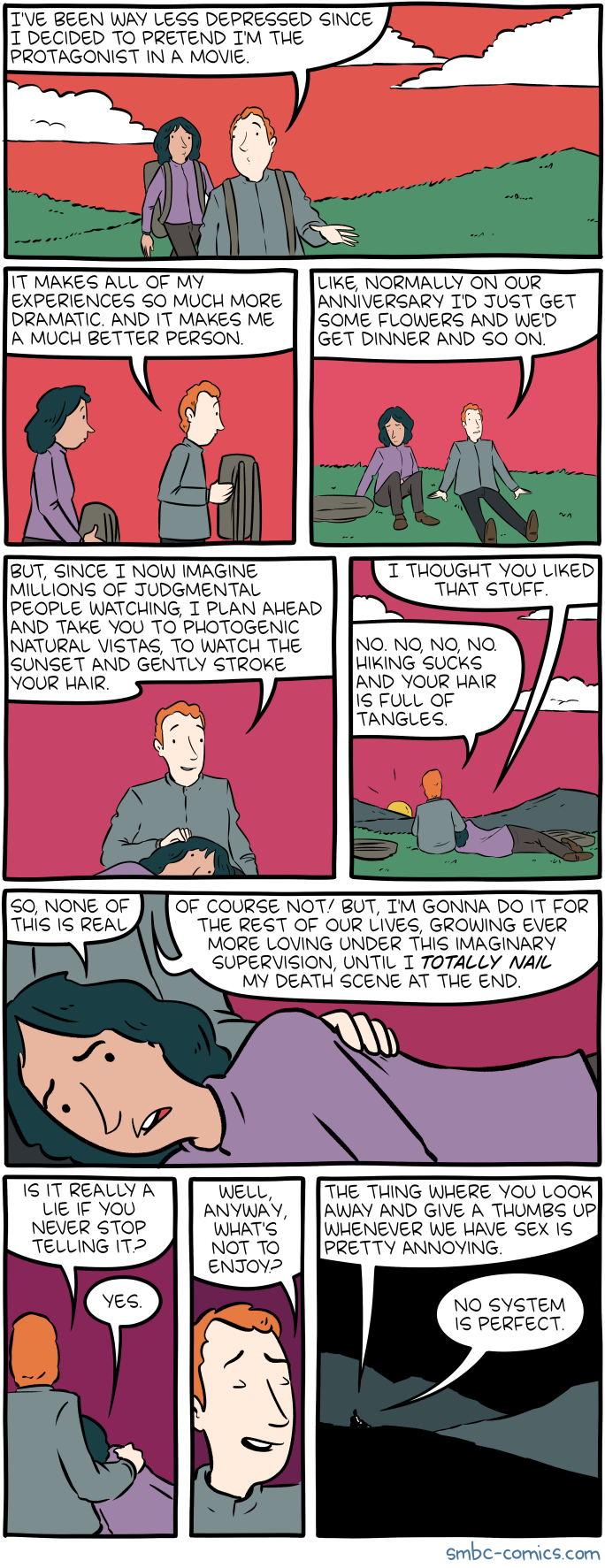
The comic depicts a man who has been cast as the protagonist of a movie. He explains that since becoming the lead character, his life has transformed: everything feels more dramatic, he's become a much better person, and he imagines documentary crews following him. He plans ahead and narrates his own actions as though they're being filmed, describing how he walks toward a sunset and "gently strokes" things. His partner, however, reveals that she finds these behaviors insufferable -- he's not actually being filmed, he's just become pretentious and self-absorbed.
Despite his partner's complaints, the man insists he'll keep it up, saying he'll do his best at quiet, genuine moments under her supervision until he "totally" amazes her. In the final panel, we learn there's a darkly pragmatic element: his partner notes that being a protagonist's love interest means she'll likely be killed off to give him a "turning point," which she finds "pretty annoying." The caption notes there is "no extra pay" for this role.
The Humor
The humor works on multiple levels. First, it satirizes the self-important behavior of people who start treating their own lives as cinematic narratives -- narrating their actions, posing dramatically, and acting as though everything is deeply meaningful. The comic mocks the idea that being a "protagonist" automatically makes someone more interesting or noble when, in reality, it just makes them annoying to the people around them. Second, there's a sharp meta-joke about storytelling tropes: the love interest in movies frequently exists only to be harmed or killed to motivate the male protagonist (the classic "fridging" trope), and the woman's weary acknowledgment that this fate awaits her adds a layer of genre-savvy dark comedy.
References
The final panel's joke about the love interest being killed for the protagonist's character development references the well-known "Women in Refrigerators" trope, coined by comic book writer Gail Simone in 1999, which critiques the tendency in fiction to harm female characters primarily to advance a male character's storyline.