quantum-weirdness
Explanation
The Joke
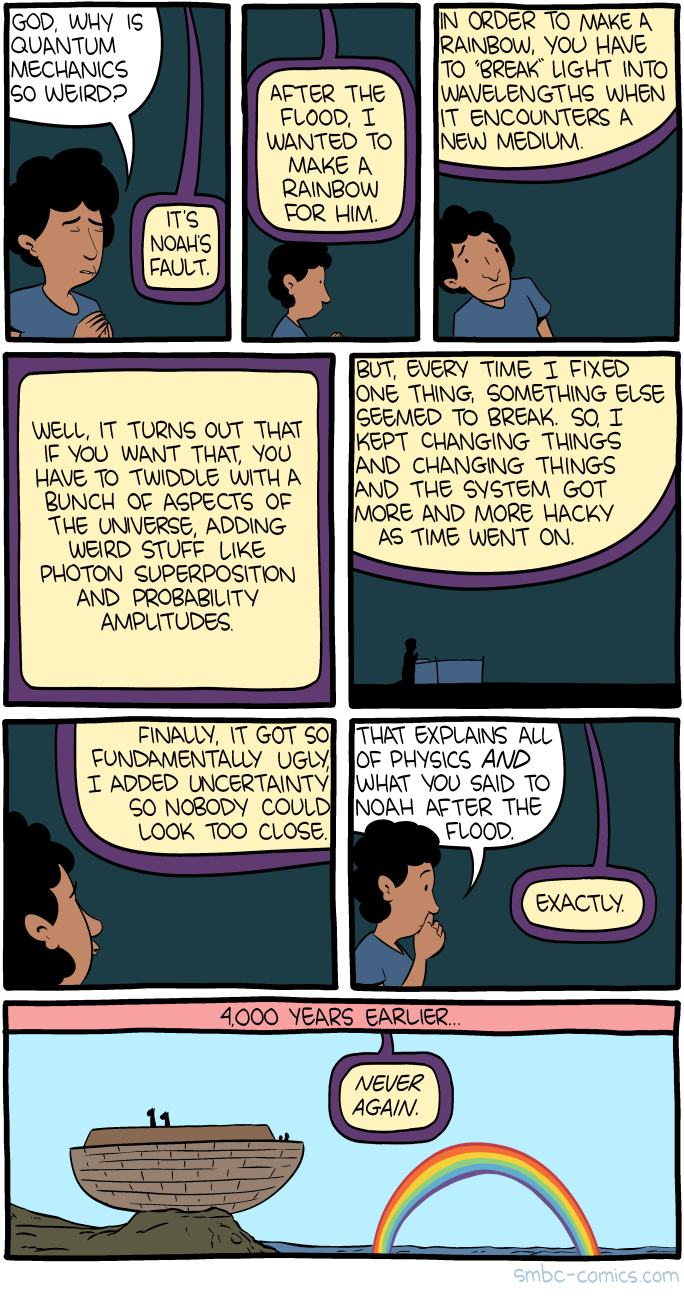
A woman complains, "God, why is quantum mechanics so weird?" God appears and explains that it is His fault. He says that to make a rainbow, He had to break light into wavelengths using diffraction, which required treating light as a wave. But He also wanted a particle-based rainbow for Noah's Ark, so He needed light to behave as both a wave and a particle.
God continues: every time He tried to add a feature to the universe, He had to "twiddle with a bunch of settings and change things," and the system got more and more hacked together over time. He kept adding "weird stuff like superposition and probability amplitudes." Finally, it got "so fundamentally ugly" that He made the universe very small "so nobody could see the code." A woman responds, "So because all of physics and God are lazy, we get the universe?" God says, "Exactly."
The final panel shows Noah's Ark, 4,000 years earlier, with Noah looking at a rainbow and saying "Never again," echoing God's Biblical promise -- but in this context implying Noah is reacting to the spaghetti code of the universe.
The Humor
The comic reimagines quantum mechanics as the result of divine spaghetti code -- God as an incompetent programmer who kept bolting on features without refactoring, resulting in an increasingly messy and unintuitive codebase. Wave-particle duality, superposition, and probability amplitudes are not elegant features of reality but ugly hacks that God made very small so nobody would notice. This is a deeply relatable metaphor for anyone who has worked in software engineering: the universe is legacy code that nobody wants to touch. The Noah's Ark punchline at the end ties the Biblical narrative back into the programming metaphor, suggesting that even God's covenant with Noah was really just a promise to stop pushing updates to production.
References
The comic references wave-particle duality, one of the central puzzles of quantum mechanics, in which light and matter exhibit properties of both waves and particles depending on how they are observed. It also alludes to the Copenhagen interpretation and the measurement problem. The Noah's Ark reference is to Genesis 9:13-17, where God places a rainbow in the sky as a sign of His covenant never to flood the Earth again.