quorf
Explanation
The Joke
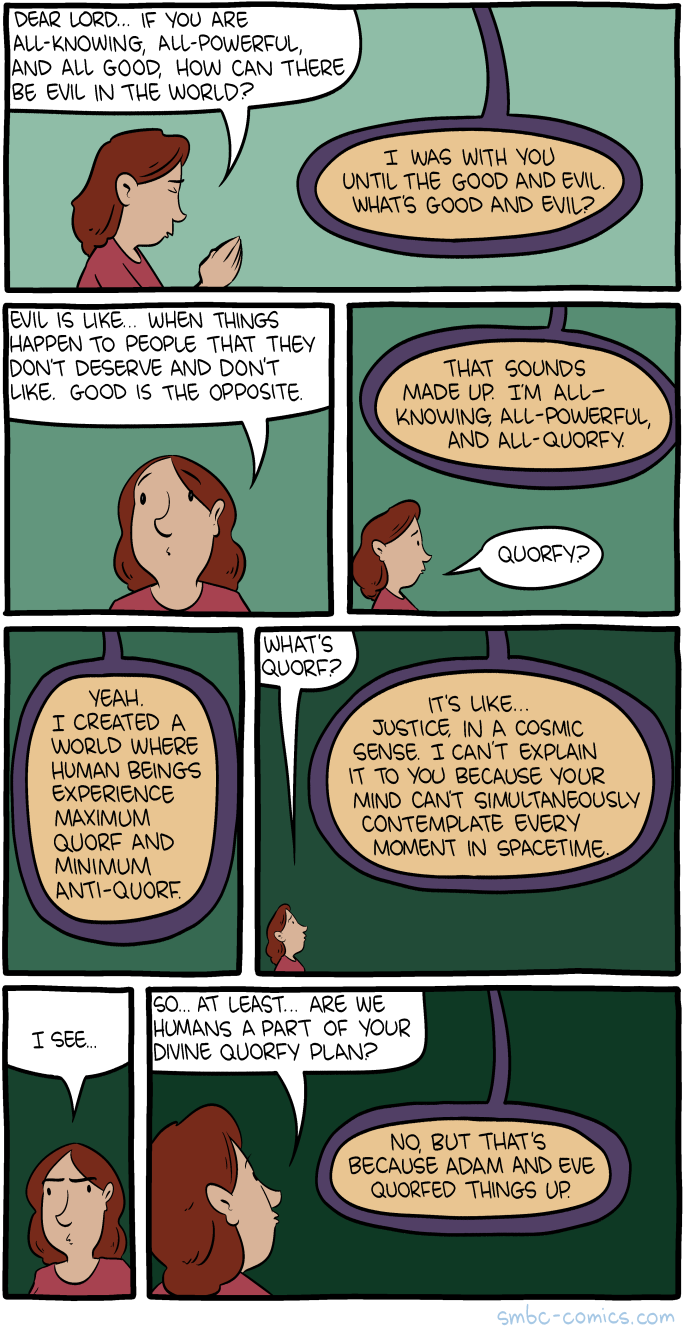
A woman is having a theological debate with God (depicted as a green figure in a dark void). She poses the classic Problem of Evil: "Dear God, if you are all-knowing, all-powerful, and all good, how can there be evil in the world?" God responds: "I was with you until the 'good and evil, what's good and evil?'" -- essentially dodging the question by questioning the premise. The woman presses on, trying different framings: "It's like, horrible things happen, people don't deserve it, and don't we agree good is the opposite?" God responds with apparent confusion: "That sounds like you set up the whole all-knowing, all-powerful, and all-good thing... Quorfly?"
The word "quorf" (or "quorfly") appears to be God's nonsensical attempt at describing the situation, suggesting that God either does not understand human moral categories or operates on a completely alien framework. The woman tries again with analogies ("It's like a cosmic genre I can't explain..."), and God keeps responding in ways that suggest divine omniscience does not include comprehension of human moral philosophy. The final panel reveals that "this became Adam and Eve's quarrel," grounding the absurd theological dialogue in the origin story of the first human disagreement.
The Humor
The comedy comes from inverting the traditional Problem of Evil. Usually, the challenge is: "How can a good God allow evil?" Here, the problem is that God simply does not understand what "good" and "evil" mean in human terms. God is all-knowing but apparently knows things in categories that do not map onto human moral experience. The invented word "quorf" is the perfect encapsulation of this communication breakdown -- it is the divine equivalent of a shrug. The joke suggests that theodicy is not a problem of God being indifferent to evil, but of God and humans literally speaking different conceptual languages.
References
The comic engages with the Problem of Evil (theodicy), one of the oldest questions in philosophy of religion, classically formulated by Epicurus and extensively debated by thinkers from Augustine to Leibniz to Plantinga. The final reference to Adam and Eve ties the abstract philosophical discussion to the Genesis creation narrative.