rapunzel-2
Explanation
The Joke
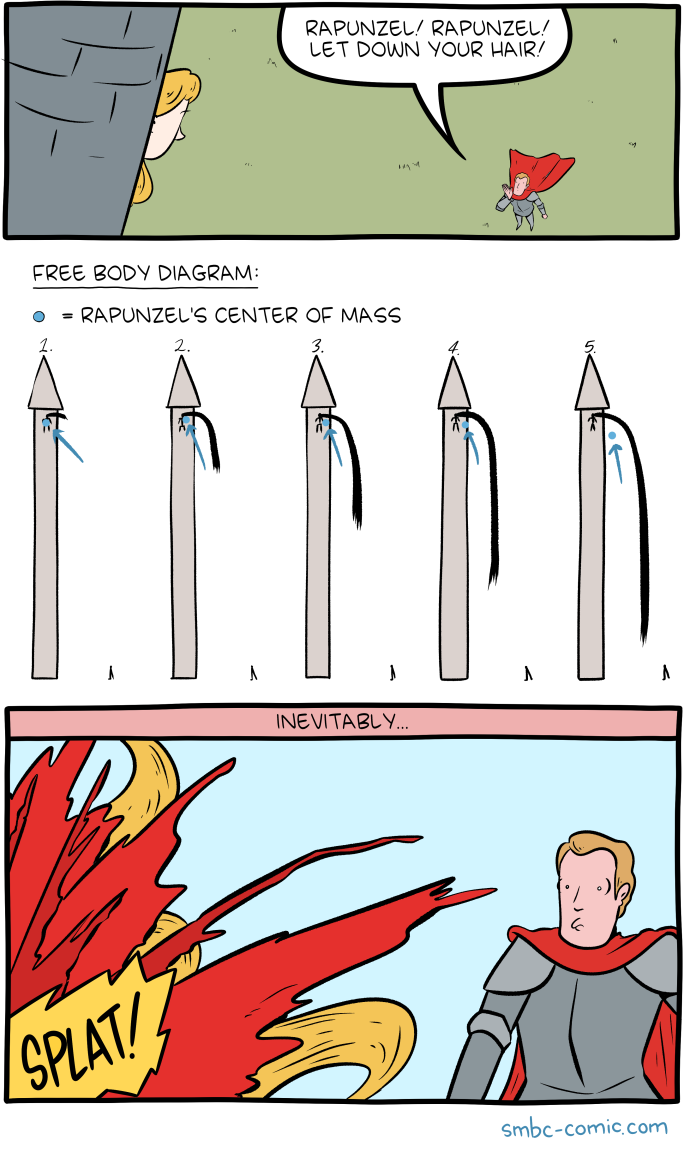
The comic reimagines the fairy tale of Rapunzel through the lens of physics. A knight calls up to a tower, "Rapunzel, Rapunzel! Let down your hair!" In the next section, labeled "Free Body Diagram," the comic shows a physics analysis of what would actually happen: a series of diagrams depict Rapunzel's center of mass shifting as the knight begins climbing her hair. Because her hair is attached to her head and the knight's weight pulls from outside the tower, the inevitable result is that Rapunzel gets yanked out of the window. The final panel shows Rapunzel splatting on the ground with the knight standing nearby in armor, unfazed.
The comic applies real physics to a fairy tale scenario that audiences normally accept without question. A free body diagram is a standard tool in introductory physics courses used to analyze forces acting on an object. Here, it makes brutally clear that a person leaning out of a tower window while someone climbs their hair would simply be pulled out and fall to their death.
The Humor
The humor derives from the collision of rigorous scientific analysis with a whimsical fairy tale. The "free body diagram" label gives the gag an academic formality that contrasts sharply with the gruesome outcome. The step-by-step progression of Rapunzel's center of mass shifting further and further over the window ledge creates a slow-motion inevitability that makes the final splat both predictable and satisfying. It belongs to a rich tradition of applying physics to fictional scenarios to reveal how absurd they really are.
References
A free body diagram is a fundamental tool in Newtonian mechanics, taught in introductory physics courses, used to visualize all forces acting on a body. The center of mass concept is key here: once Rapunzel's center of mass passes beyond the support of the window ledge, no amount of grip strength can prevent a fall. The fairy tale of Rapunzel originates from a story published by the Brothers Grimm in 1812.