ratio
Explanation
The Joke
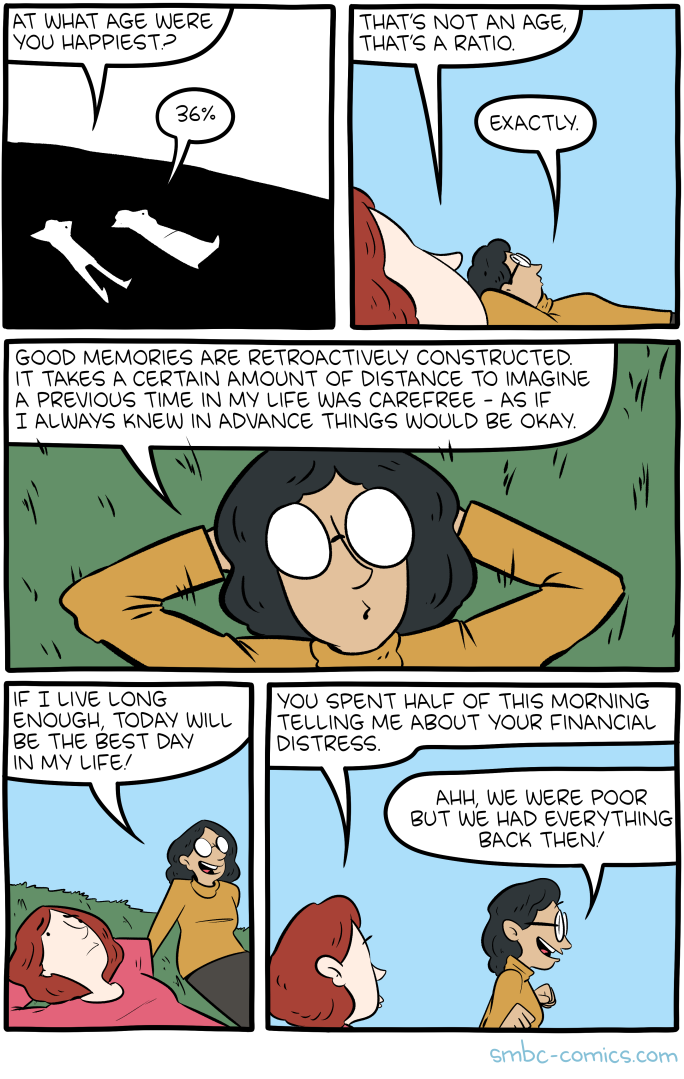
The comic explores the psychology of nostalgia and how memory distorts our perception of the past. In the first panel, someone asks "At what age were you happiest?" and a woman lying on the grass answers "Nine." She is then told "That's not an age, that's a ratio," to which she responds "Exactly."
The next panels explain her meaning: "Good memories are retroactively constructed. It takes a certain amount of distance to misremember a period. The time in my life was crappiest, like a 2, but put a few decades in between and things would be okay." The idea is that happiness is not an absolute state at a given age but a ratio between how bad things actually were and how much time has passed to allow rosy retrospection to set in.
The comic then takes a darker turn: "If I live long enough, today will be the best day of my life" -- suggesting that even a terrible present will eventually be remembered fondly given enough time. The final panel undercuts this with someone saying "You spent half of this morning telling me about your profound distress" and she responds "All we're poor, but we had each other" -- already retroactively rewriting the present moment into a warm nostalgic memory even as it is happening.
The Humor
The humor comes from the uncomfortable truth about how nostalgia works. The observation that happiness is a "ratio" rather than an absolute value is genuinely insightful -- we really do tend to remember the past more fondly the further away it gets, regardless of how we felt at the time. The final panel pushes this to its absurd conclusion: the woman is already performing nostalgic revision on the present moment, repackaging her current misery as a charming story about being poor but having love. It satirizes the way people romanticize hardship, but only in retrospect.
References
The comic touches on the psychological concept of "rosy retrospection," a well-documented cognitive bias in which people recall past events more positively than they actually experienced them at the time. This is related to the broader phenomenon of nostalgia, which research has shown tends to increase with temporal distance from the remembered event.