rational-3
Explanation
The Joke
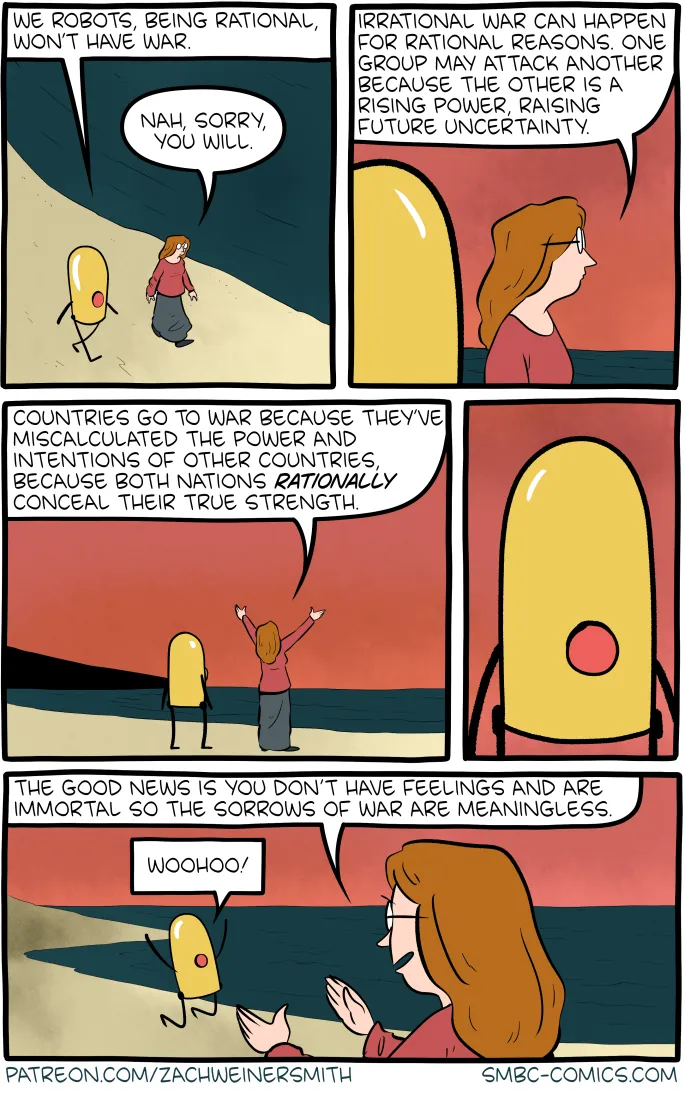
A small yellow robot confidently declares, "We robots, being rational, will not have war." A human woman responds, "Nah, sorry, you will." She explains that irrational war can happen for rational reasons: one group may attack another because the other is a rising power, raising future uncertainty. She elaborates that countries go to war because they have miscalculated the power and intentions of other countries, and crucially, that both nations rationally conceal their true strength -- meaning that the information asymmetry that causes war is itself a product of rational behavior.
In the final panel, the woman delivers the consolation prize: "The good news is you do not have feelings and are immortal, so the sorrows of war are meaningless." The robot cheers, "Woohoo!"
The Humor
The comic engages with a serious idea from international relations theory -- specifically the rationalist explanations for war associated with scholars like James Fearon. The conventional intuition is that war is irrational because it is destructive and costly for all sides, so rational actors should always prefer to negotiate. However, Fearon and others have shown that war can arise precisely because rational actors have incentives to misrepresent their strength and resolve, creating information problems that make negotiated settlements fail.
The robot embodies the naive techno-optimist assumption that rationality automatically prevents conflict. The woman (representing the informed human perspective, in a nice role reversal) dismantles this assumption by showing that rationality can produce war rather than prevent it. The word "rationally" is bolded and italicized in the comic to emphasize the irony: the very rationality the robot is proud of is what causes the concealment that leads to miscalculation and war.
The final punchline pivots to dark comedy: since robots lack feelings and cannot die, the actual suffering caused by war does not apply to them, making war merely an inconvenience rather than a tragedy. The robot cheerfully accepting this is funny because it undercuts the gravity of the preceding political science lesson. It also implicitly raises the unsettling question: if robots can wage war without suffering, would they wage it more casually than humans do?