Rationalist
Explanation
The Joke
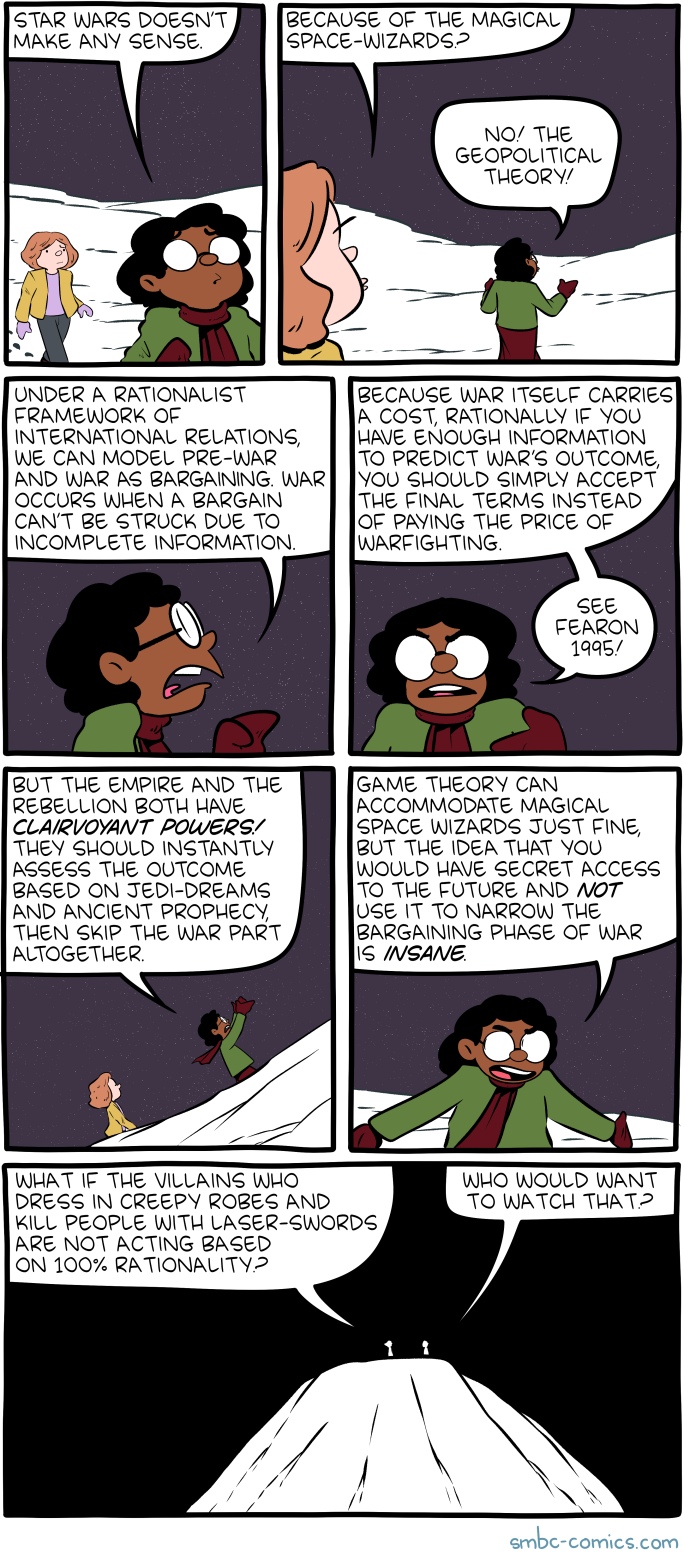
Two people are in bed having a debate about Star Wars. One argues that Star Wars doesn't make sense because of the "magical space wizards." The other responds: "No! The geopolitical theory!" They argue that the franchise's depiction of interstellar relations, galactic governance, and warfare doesn't hold up — that Star Wars implicitly carries certain assumptions about power, bargaining, and empire that can't be explained solely by the Force or magic.
The other person counters that "game theory can accommodate magical space wizards just fine" — you could model characters who have secret access to mystical powers, and the strategic analysis would still work. They continue debating whether the Empire and the Rebellion make sense as political entities, eventually concluding the argument with an exasperated exchange. The final panel shows the villains in "creepy robes" and one person asking "who would want to watch that?"
The Humor
The comic satirizes a certain type of overly analytical fan (often associated with rationalist communities) who critiques fictional universes not for their storytelling but for their failure to conform to rigorous political science, game theory, or economics. The joke is that applying real-world international relations theory to Star Wars — a space opera deliberately built on mythological archetypes — is both technically valid and utterly beside the point.
Weinersmith captures the absurdity of the rationalist impulse to systematize everything: the characters are literally in bed together, having what should be pillow talk, but instead they're deep in a heated debate about whether the Galactic Empire's power structure is consistent with realist IR theory. The final panel's question ("who would want to watch that?") serves as self-aware commentary — the rationalist critique, even if correct, would make for a terrible movie.