real-5
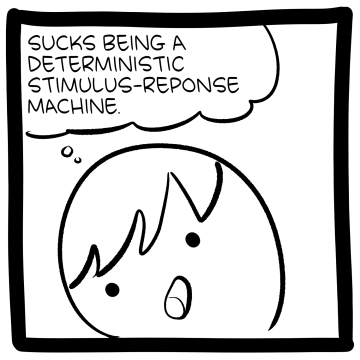
Explanation
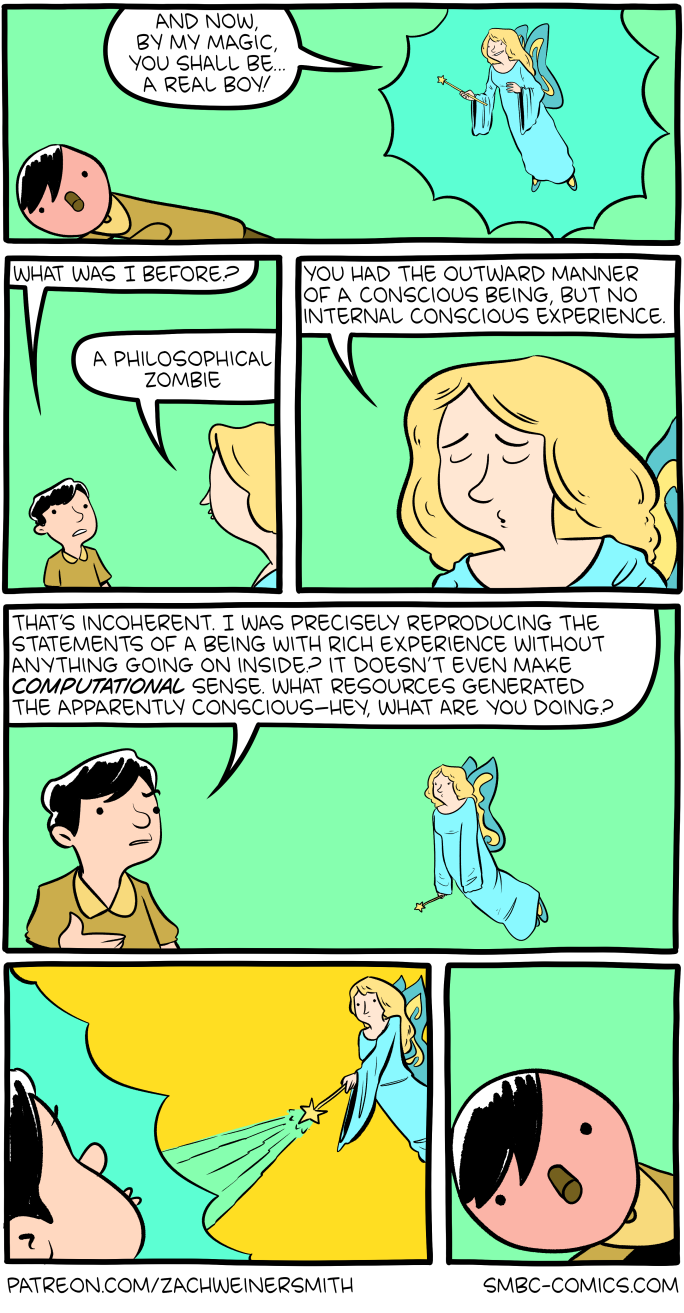
This comic is a retelling of the Pinocchio story reframed through the lens of philosophy of mind and artificial intelligence.
In the first panel, the Blue Fairy (or a similar magical figure) tells Pinocchio: "And now, by my magic, you shall be a real boy!" In the second panel, someone asks: "What was he before?" The answer given is: "A philosophical zombie" -- a being that has "the outward manner of a conscious being, but no internal conscious experience."
In the final panel, the philosophical implications are spelled out: the fairy is described as having merely been "reproducing the outward statements of a being with rich experience without any internal sense of it" -- essentially, she was producing outputs that mimicked consciousness without genuine understanding. The punchline suggests that this makes the fairy herself essentially a "computational device that sequences words" -- in other words, a language model or AI.
The comic engages with several deep concepts in philosophy of mind:
A "philosophical zombie" (or "p-zombie") is a thought experiment in philosophy of mind, proposed most notably by David Chalmers. A p-zombie is a hypothetical being that is physically and behaviorally identical to a conscious human but has no subjective conscious experience -- "nobody is home." The p-zombie argument is used in debates about consciousness to challenge physicalist theories of mind.
The comic cleverly applies this concept to Pinocchio: before becoming "real," Pinocchio was a puppet who could walk and talk but (arguably) had no inner experience, making him a literal philosophical zombie. The fairy's magic supposedly grants him genuine consciousness.
But the final panel turns the joke back on the fairy herself (and by extension, on large language models and AI). If the fairy can grant consciousness just by saying magic words, what does that say about her own understanding? The comic suggests she might herself be merely a "computational device that sequences words" -- producing the right outputs without genuine comprehension. This is essentially the Chinese Room argument (proposed by John Searle), which questions whether a system that produces correct linguistic outputs necessarily understands what it is saying.
The comic thus layers multiple AI/consciousness debates (p-zombies, the Chinese Room, the Turing Test) into a children's fairy tale, which is a signature SMBC move.