recreation
Explanation
The Joke
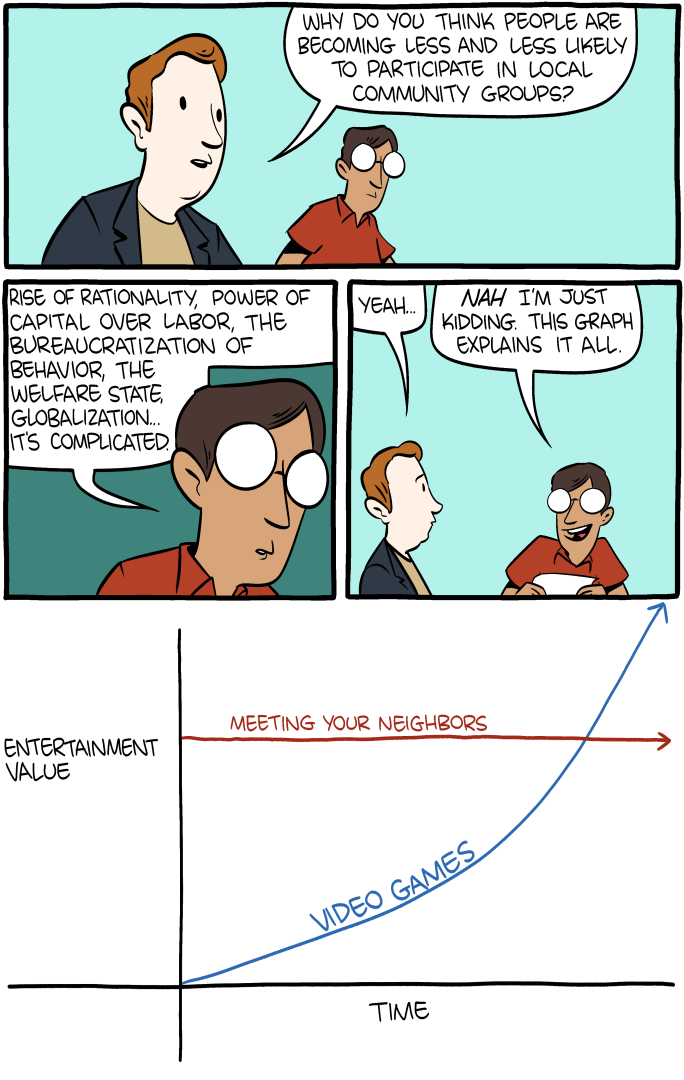
The comic opens with one character asking why people are becoming less and less likely to participate in local community groups. The other character, wearing glasses, launches into a serious sociological analysis: "Rise of rationality, power of capital over labor, the bureaucratization of behavior, the welfare state, globalization... it is complicated." The first character agrees with a "Yeah."
But then glasses-guy immediately reverses course: "Nah, I am just kidding. This graph explains it all." The graph below shows two lines plotted against axes of "Entertainment Value" vs. "Time." One flat red line represents "Meeting Your Neighbors," which remains constant and low over time. The other blue line, labeled "Video Games," curves exponentially upward, eventually soaring far above the neighbor line.
The Humor
The humor comes from the dramatic pivot between a nuanced, academic explanation and a brutally simple one. The first answer references serious sociological theories about the decline of civic engagement -- the kind of factors discussed in books like Robert Putnam's Bowling Alone. But the comic argues that all of these sophisticated explanations are overthinking it. The real reason people stopped joining community groups is simply that video games (and by extension, home entertainment) got really, really good. Why go to a neighborhood potluck when you can explore a virtual world?
The exponential curve of video game entertainment value versus the flat line of neighbor interactions is a funny visual punchline because it reduces a complex sociological phenomenon to a straightforward cost-benefit analysis that most people can instinctively relate to.
References
The question of declining civic participation is most famously explored in Robert Putnam's 2000 book Bowling Alone: The Collapse and Revival of American Community, which documents the decline of social capital in the United States and attributes it to many of the factors the character initially lists (suburbanization, technology, generational change, etc.). The comic playfully suggests Putnam could have saved a lot of pages.