rehash
Explanation
The Joke
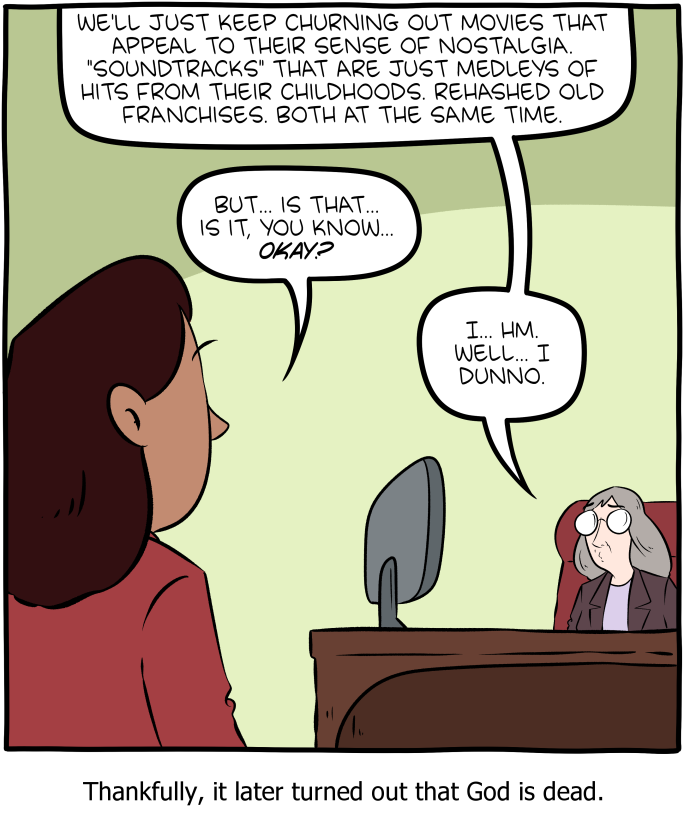
Two characters, apparently entertainment industry executives, discuss their strategy for making content. One explains the plan: "We'll just keep churning out movies that appeal to their sense of nostalgia. 'Soundtracks' that are just medleys of hits from their childhoods. Rehashed old franchises. Both at the same time." The other character hesitantly asks, "But... is that... is it, you know... okay?" The first pauses and responds, "I, um, well... I dunno." The caption at the bottom delivers the punchline: "Thankfully, it later turned out that God is dead."
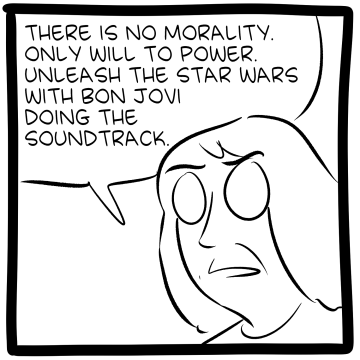
The comic satirizes the modern entertainment industry's heavy reliance on nostalgia-driven reboots, remakes, sequels, and franchise revivals. The executives themselves seem uneasy about the morality of endlessly recycling old material, but the existential punchline suggests that since there is no higher moral authority watching, they can get away with it.
The Humor
The comedy works on multiple levels. First, it captures the genuine awkwardness of an industry that knows it is being creatively lazy but cannot stop because the formula is profitable. The hesitant "is that... okay?" is a perfect parody of half-hearted moral qualms. Second, the caption's invocation of Nietzsche's famous declaration "God is dead" as a punchline is absurdly disproportionate -- using one of philosophy's most profound existential observations merely to justify the existence of yet another nostalgia-bait franchise reboot.
References
The caption "God is dead" references Friedrich Nietzsche's famous proclamation from "The Gay Science" (1882), which was not a literal theological claim but a commentary on the decline of absolute moral frameworks in modern society. Here, Weinersmith uses it comedically to suggest that without a moral arbiter, there is nothing to stop the entertainment industry from its creative bankruptcy.