reverse-victorianism
Explanation
The Joke
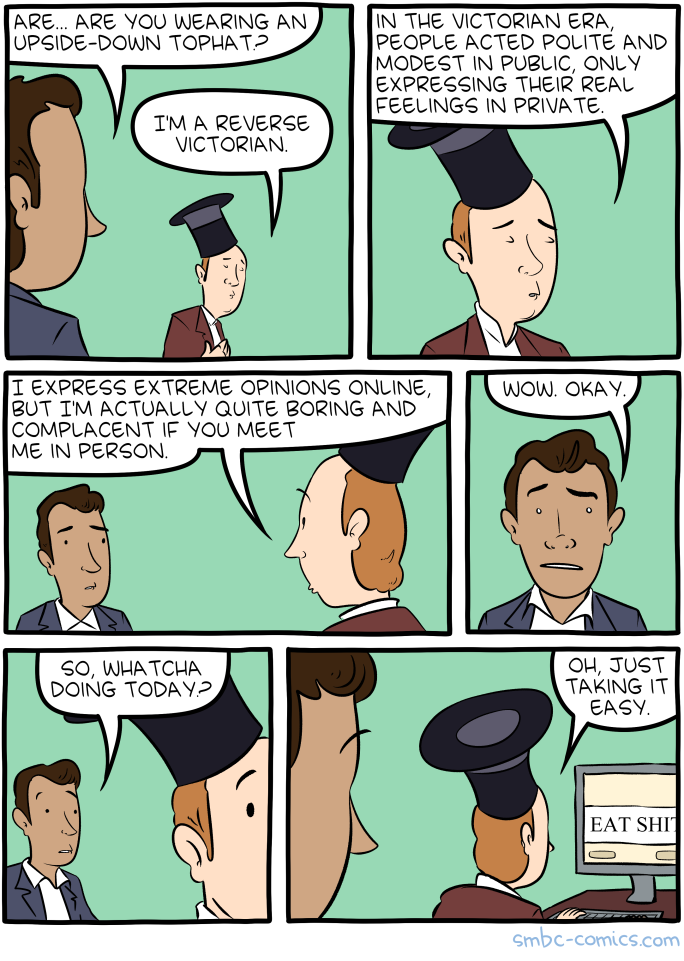
A man notices that his colleague is wearing an upside-down top hat and asks about it. The colleague explains that he is a "reverse Victorian." In the Victorian era, people maintained rigid public propriety while hiding their true feelings and desires behind social convention. A reverse Victorian, he explains, does the opposite: he expresses extreme opinions and crude behavior in public, but in private he is actually boring, mild, and complimentary. When asked "So what are you doing today?" his private response is the utterly bland "Oh, just taking it easy."
The final panel shows the reverse Victorian in private, being completely ordinary and polite, confirming that his outrageousness is entirely performative and his real self is dull.
The Humor
The comic satirizes a recognizable modern personality type: people who cultivate an outrageous, provocative, or edgy public persona but are actually quite ordinary in private. The Victorian comparison is clever because it inverts a well-known cultural observation -- Victorians were famous for being publicly proper but privately scandalous (or at least repressed). The reverse Victorian is publicly scandalous but privately proper. The joke suggests that performative outrageousness is just another form of social mask, no more authentic than Victorian prudishness. The inverted top hat is a perfect visual gag to represent this inversion -- taking the quintessential symbol of Victorian propriety and literally flipping it.
References
The Victorian era (1837-1901) is commonly associated with strict social codes, public propriety, and sexual repression, though historians note that private behavior often contradicted these public standards. The comic plays on this popular understanding of Victorian culture as a foil for modern social media behavior, where people often perform exaggerated versions of themselves in public.