reverse
Explanation
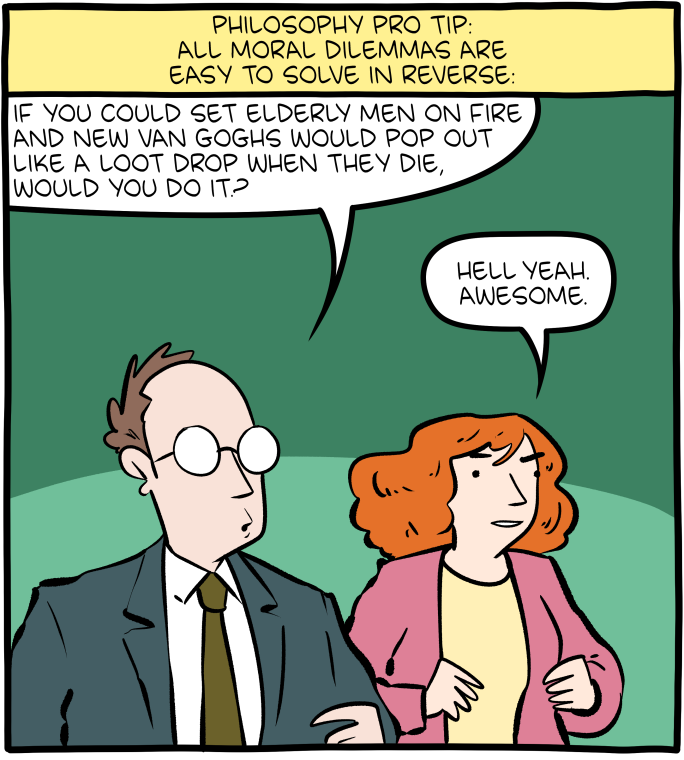
This comic offers a "Philosophy Pro Tip" that reads: "All moral dilemmas are easy to solve in reverse." It then demonstrates with an example: "If you could set elderly men on fire and new Van Goghs would pop out like a loot drop when they die, would you do it?" The woman enthusiastically responds: "Hell yeah. Awesome."
The joke is a clever inversion of the classic trolley problem and similar utilitarian thought experiments. Normally, these dilemmas ask whether it is acceptable to sacrifice something of lesser value (pulling a lever, pushing someone off a bridge) to achieve a greater good. They feel agonizing because they involve doing harm. But when you reverse the framing -- presenting the harmful act as the starting point and the good outcome as a bonus reward -- the dilemma evaporates. Setting people on fire for art sounds like a fun video game mechanic rather than a moral quandary. The comic highlights how moral intuition is heavily dependent on framing: the same trade-off (human life vs. priceless art) feels completely different depending on which direction you present the causality. The "loot drop" language deliberately evokes video game logic, further defusing the moral weight.