Ring
Explanation
The Joke
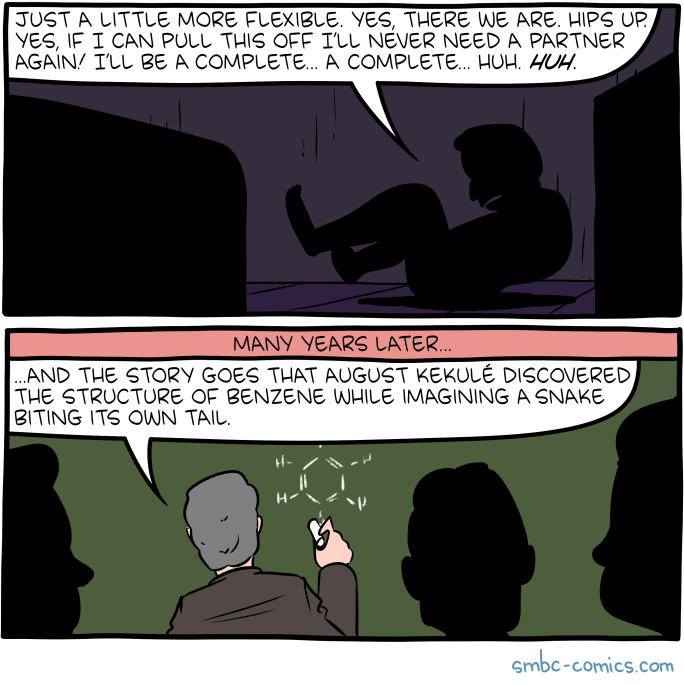
The comic is presented in two panels. In the first, we see a shadowy silhouette of a person contorting their body in what appears to be an attempt to bite their own tail or form a ring shape with their body. The person is muttering: "Just a little more flexible. Yes. There we are. Hips up. Yes. If I can pull this off I'll never need a partner again. I'll be a complete... a complete... huh. Huh."
The second panel, captioned "Many years later," shows a classroom or lecture setting where a teacher explains: "...and the story goes that August Kekule discovered the structure of benzene while imagining a snake biting its own tail."
The Humor
The comic sets up a deliberately misleading first panel. The shadowy silhouette and the dialogue about flexibility, not needing a partner, and becoming "complete" strongly implies a sexual act of self-gratification. The reader is led to assume the person is attempting something salacious. The punchline completely recontextualizes the scene: it was actually the famous chemist August Kekule having his eureka moment about the ring structure of benzene, inspired by a vision of a snake biting its own tail (the ouroboros). The "huh" moment is him realizing the molecule is circular.
The misdirection is the primary comedic engine here. Weiner sets up expectations in one direction and then pulls the rug out with a wholesome (if eccentric) scientific anecdote. The joke works on two levels: the bait-and-switch itself, and the absurd image of Kekule physically trying to form a ring shape with his own body to understand molecular structure.
References
August Kekule (1829-1896) was a German organic chemist who is credited with discovering the ring structure of benzene (C6H6). He famously claimed that the idea came to him in a daydream of a snake seizing its own tail, an image known as the ouroboros. This story, whether literally true or apocryphal, is one of the most famous anecdotes in the history of chemistry. The ouroboros itself is an ancient symbol depicting a serpent eating its own tail, representing cyclicality and self-reference.