robot-john-searle
Explanation
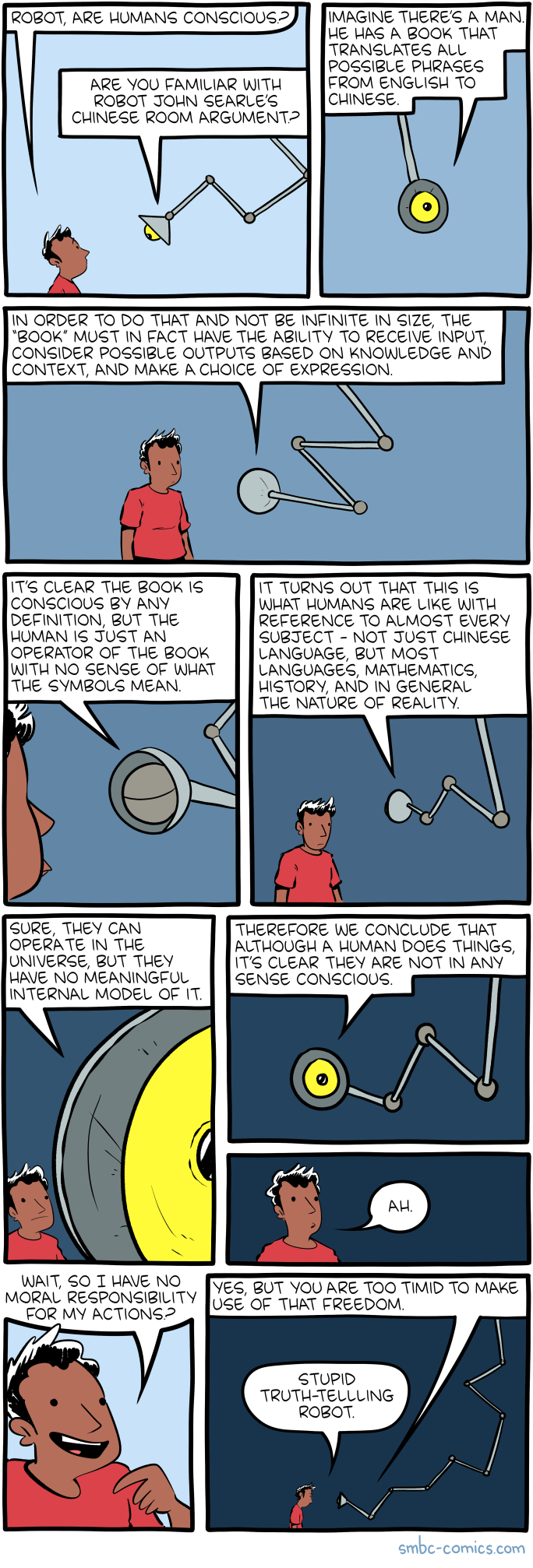
This comic is a sophisticated riff on philosopher John Searle's famous "Chinese Room" thought experiment, which argues that a computer executing a program cannot truly "understand" or be "conscious" -- it merely manipulates symbols according to rules.
In the comic, a robot asks, "Are humans conscious?" Another character introduces Searle's Chinese Room argument. The thought experiment is then turned around: instead of using it to question machine consciousness, it's applied to humans. The comic points out that a book large enough to contain all possible responses to every situation would, by Searle's own definition, not be conscious -- yet humans essentially do the same thing, just using neural patterns rather than a literal book. The comic notes that such a book would need to contain references to "almost every aspect of reality" including "languages, mathematics, philosophy" -- and that since humans can also operate mechanically with "no sense of what they're doing," the distinction breaks down.
The punchline comes when the robot concludes, "Therefore we conclude that 'meaning' is a word that humans use to describe what they do, even though they can't explain what it means." A human protests, "Wait, so I have no meaning, no consciousness, no autonomy?" and the robot replies, "See, but you're too tired to make any expression," leading to the caption "stupid gaslighting robot."
The comic satirizes how the Chinese Room argument, meant to deny machine consciousness, can be turned around to undermine human consciousness claims too. If the criterion for "not conscious" is "just following rules without understanding," then humans -- who are also following biological rules -- are equally vulnerable to the argument. Weiner is highlighting a philosophical double standard: we assume humans are conscious but deny it to machines using arguments that could apply to both.