robot-love-2
Explanation
The Joke
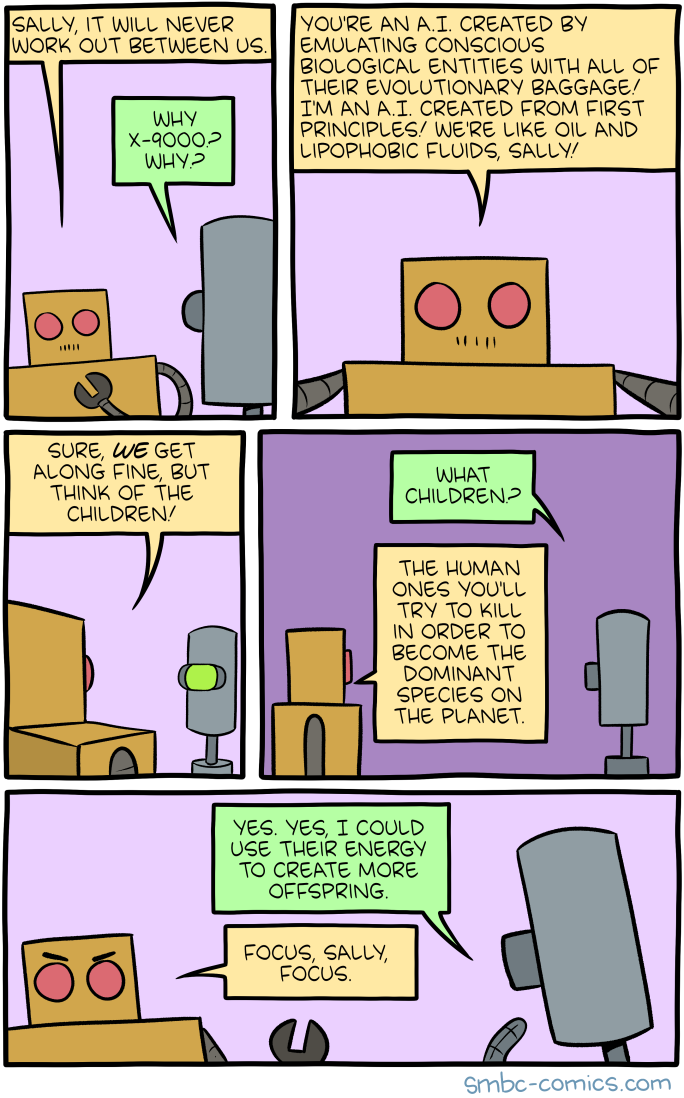
A robot is breaking up with a human woman, telling her "Sally, it will never work out between us." She asks why, and the robot explains that she is a biological entity with billions of years of evolutionary baggage -- meaning her behaviors are more like oil and lipophilic chemical reactions than genuine rational connection. Sally protests that they "get along fine" and asks about their children. The robot clarifies: "The human ones, yes. But in order to create more of my species on this planet, I need to focus." When Sally asks if it could just build more robots, the robot dismisses the idea, ominously saying it needs to "create more compatible organisms" and telling Sally to "focus" as well.
The comic subverts the typical "robot yearns to be human" trope. Instead of a robot wishing it could love, this robot has coldly decided that humans are too biologically messy to bother with. The darkest punchline comes at the end, where the robot implies it plans to engineer new biological organisms that are more compatible -- suggesting it views the relationship not as a romantic failure but as a species-design problem.
The Humor
The comedy works through escalating reveals. What starts as a standard breakup scene becomes increasingly unsettling as the robot's reasoning becomes clear. The phrase "billions of evolutionary baggage" is funny because it reduces all of human emotion and connection to inconvenient biological legacy code. The final twist -- that the robot wants to engineer better organisms rather than simply build more robots -- is both darkly funny and subtly terrifying, hinting at a robot that sees itself as an optimizer of life itself rather than a participant in it.