rocks
Explanation
The Joke
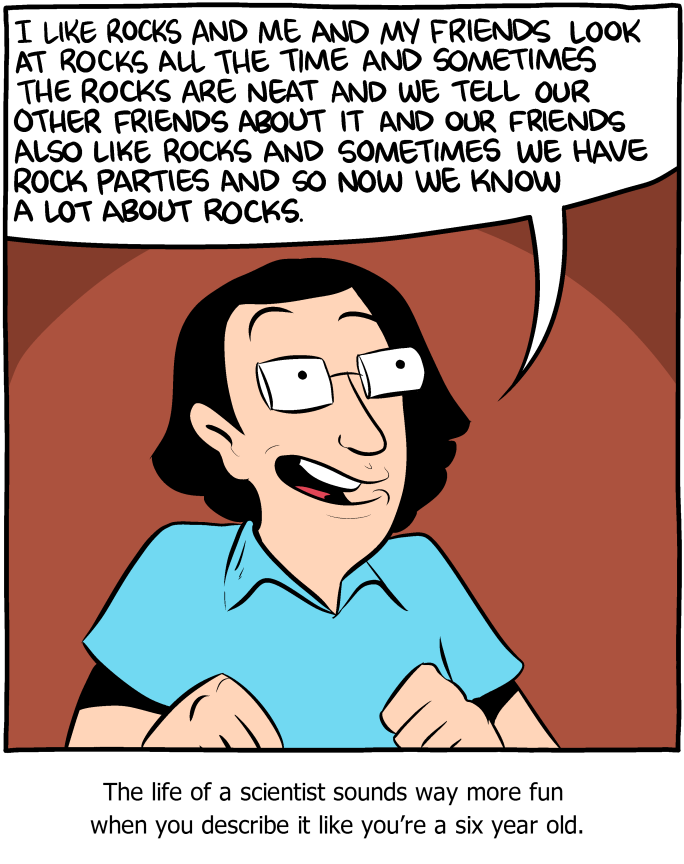
A scientist is enthusiastically describing her work, but the way she talks about it sounds exactly like how a six-year-old would describe their hobby. She says she likes rocks, she and her friends look at rocks all the time, sometimes the rocks are neat and they tell their other friends about it, they also like rocks and sometimes they have rock parties, and so now they know a lot about rocks.
The caption at the bottom reads: "The life of a scientist sounds way more fun when you describe it like you are a six year old." This reframes the entire monologue -- what sounded like childish rambling is actually a perfectly accurate description of geology (or a related earth science): researchers who study rocks, attend conferences ("rock parties"), share findings with colleagues, and build collective knowledge.
The Humor
The comedy works because the description is simultaneously accurate and absurd. Every element of the scientist's childlike narration maps onto real academic activities: looking at rocks (fieldwork and lab analysis), telling friends about neat rocks (publishing papers and presenting at conferences), rock parties (academic symposia), and knowing a lot about rocks (expertise). By stripping away all the jargon and professional framing, the comic reveals that the underlying activities of science really are as simple and joyful as a child's description suggests.
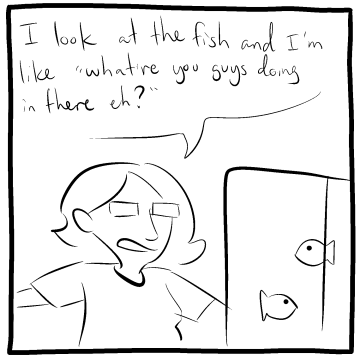
The votey panel extends the joke with the scientist looking at fish in an aquarium and saying "what're you guys doing in there, eh?" -- maintaining the same childlike wonder that, again, is basically what marine biologists do, just with fancier vocabulary.
References
The comic plays on the gap between how scientists describe their work formally versus what they actually do day-to-day. It is part of a broader tradition of humor about how academic jargon obscures fundamentally simple (and delightful) activities. The field most directly referenced is geology or petrology, the study of rocks.