rule-of-three

Explanation
The Joke
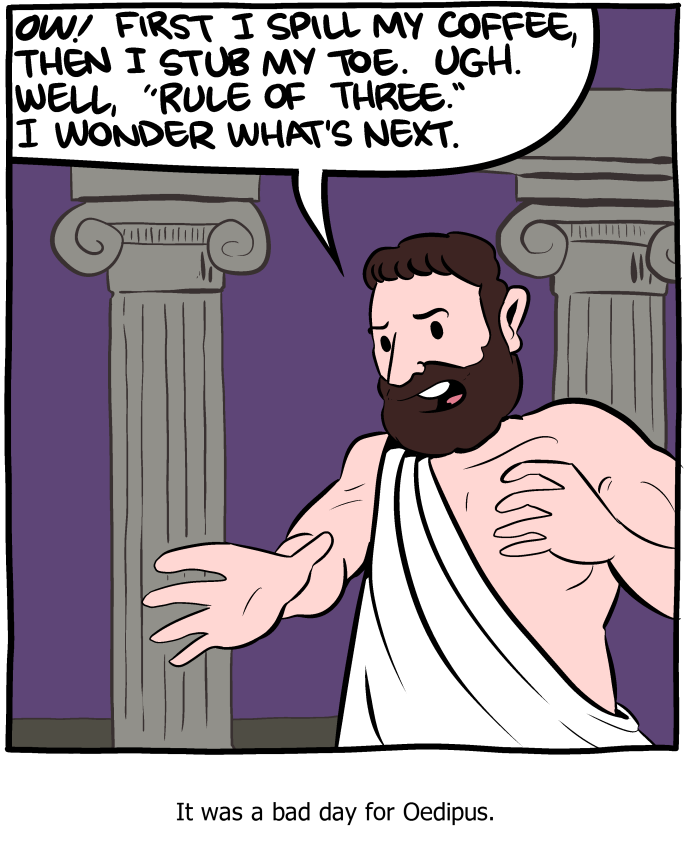
A man in ancient Greek clothing (identified in the caption as Oedipus) is having a bad day. He has spilled his coffee, stubbed his toe, and invokes the superstition "rule of three" -- the folk belief that bad things come in threes -- wondering what the third misfortune will be. The caption reads: "It was a bad day for Oedipus."
The joke is that in Greek mythology, Oedipus's famous "third bad thing" was far worse than spilling coffee or stubbing a toe: he unknowingly killed his father and married his mother. The comic imagines his day starting with minor inconveniences, with Oedipus blissfully unaware that the third event in the series will be catastrophically worse than anything he could imagine.
The Humor
The humor comes from the massive understatement and dramatic irony. The "rule of three" superstition usually applies to minor annoyances -- a flat tire, a broken mug, a stubbed toe. But for Oedipus, the third bad thing is patricide and incest, arguably the most famously horrible fate in all of Western literature. Oedipus's casual, almost bored tone ("I wonder what's next") makes the dramatic irony even funnier, since the audience knows exactly what horrors await him while he treats it like an ordinary inconvenience. There is also a subtle anachronism joke in Oedipus drinking coffee, which did not exist in ancient Greece.
References
Oedipus is the protagonist of Sophocles' tragedy "Oedipus Rex" (c. 429 BCE), in which he discovers that he has fulfilled a prophecy by killing his father Laius and marrying his mother Jocasta. The "rule of three" is a widespread superstition (sometimes phrased as "bad things come in threes") with no clear origin, though it appears across many cultures.