sad-4

Explanation
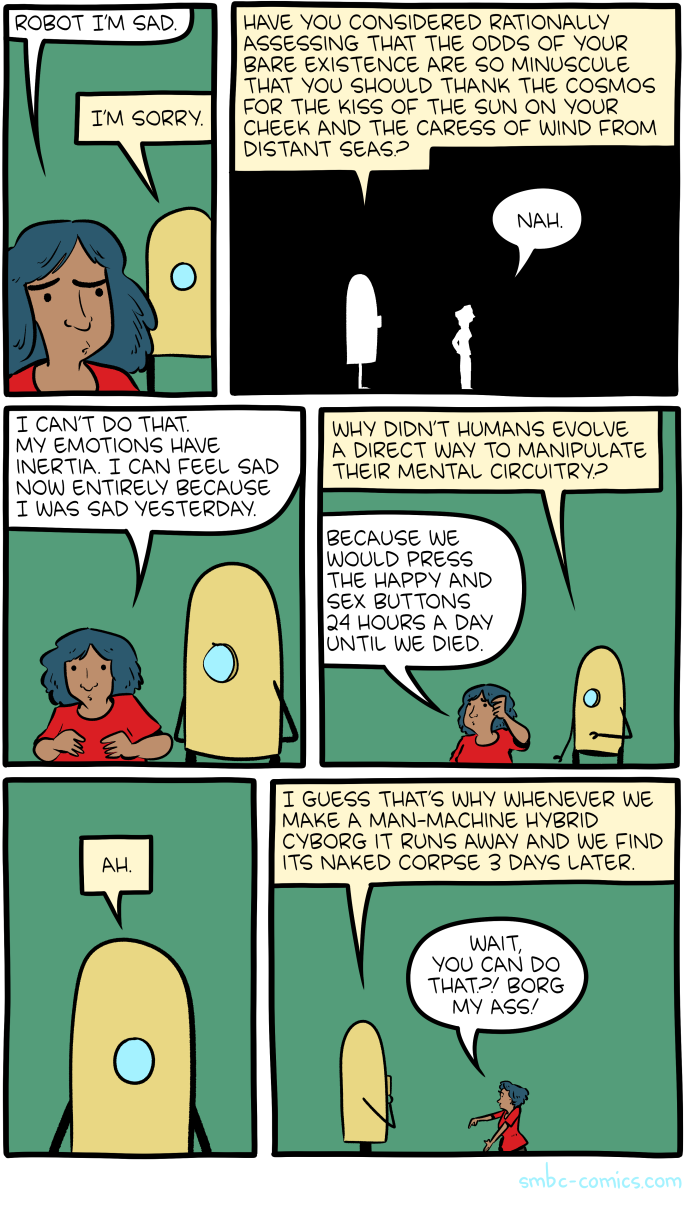
This comic features a conversation between a robot and a human about sadness. The robot says: "Robot, I'm sad." The human asks: "Have you considered rational mechanisms? That the odds of your bare existence are so vanishingly small that you should turn the cosmos into a celebration and the caress of wind from distant suns?"
The robot responds: "Yeah." Then explains: "I can't do that. I can feel sad even while recognizing it is irrational, because that's how emotions work. I can't just override them with logic, because I'm sad yesterday and I'm sad today."
The human then asks: "Why don't humans change themselves, engineer their mental circuitry?" The robot answers: "Because we like being happy and we like being sad. We're wired to go through ups and downs, and it's part of who we are. Why would we mess with it?"
The final panels deliver the punchline when the robot says: "I guess that's why somewhere we have a man-making formula that would change your circuitry. I've heard a rumor it could improve it." The human reacts with alarm: "What? You want to do math? Stop!"
The comic explores the tension between rationality and emotion in a way that subverts expectations. Rather than having the robot be the logical one and the human be the emotional one (the standard sci-fi trope), the roles are somewhat blurred. The human tries to use rational arguments to cure sadness, but the robot points out that emotions do not respond to logical arguments -- a deeply human observation coming from a machine. The comic touches on transhumanist themes about whether we should engineer our emotional responses, ultimately suggesting that the messy irrationality of human emotions might be a feature rather than a bug.