scavenger-hunt
Explanation
The Joke
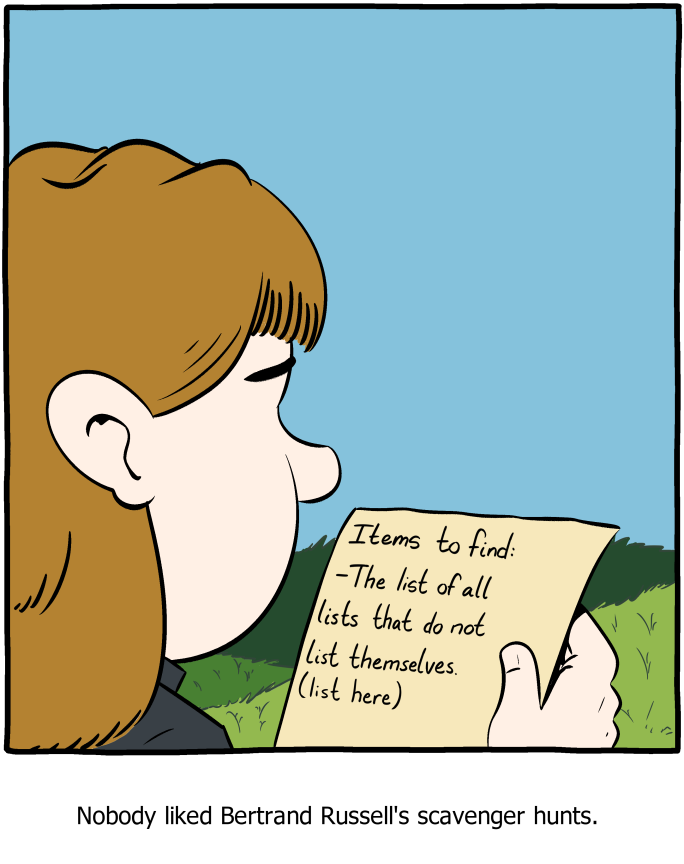
A person is reading a scavenger hunt list. The single item on the list reads: "Items to find: The list of all lists that do not list themselves. (list here)." The caption below states, "Nobody liked Bertrand Russell's scavenger hunts."
This is a direct reference to Russell's Paradox, one of the most famous problems in the foundations of mathematics and set theory. Russell's Paradox asks: "Does the set of all sets that do not contain themselves contain itself?" If it does contain itself, then by definition it should not. If it does not contain itself, then by definition it should. The paradox is inherently unsolvable -- and so is this scavenger hunt item, making it an impossible task disguised as a children's game.
The Humor
The comedy comes from placing one of the deepest logical paradoxes in history into the mundane context of a children's scavenger hunt. The caption -- "Nobody liked Bertrand Russell's scavenger hunts" -- is delivered with deadpan understatement, suggesting that Russell routinely subjected people to logically impossible recreational activities. The image of a confused person staring at an unsolvable paradox on a scrap of paper, outdoors on a sunny day, perfectly captures the absurdity of encountering foundational crises of mathematics in everyday life.
References
Bertrand Russell (1872-1970) was a British philosopher, logician, and mathematician. He discovered the paradox that bears his name in 1901, which exposed a fundamental contradiction in naive set theory and prompted major revisions to the foundations of mathematics, including the development of type theory and axiomatic set theory.