Science
Explanation
The Joke
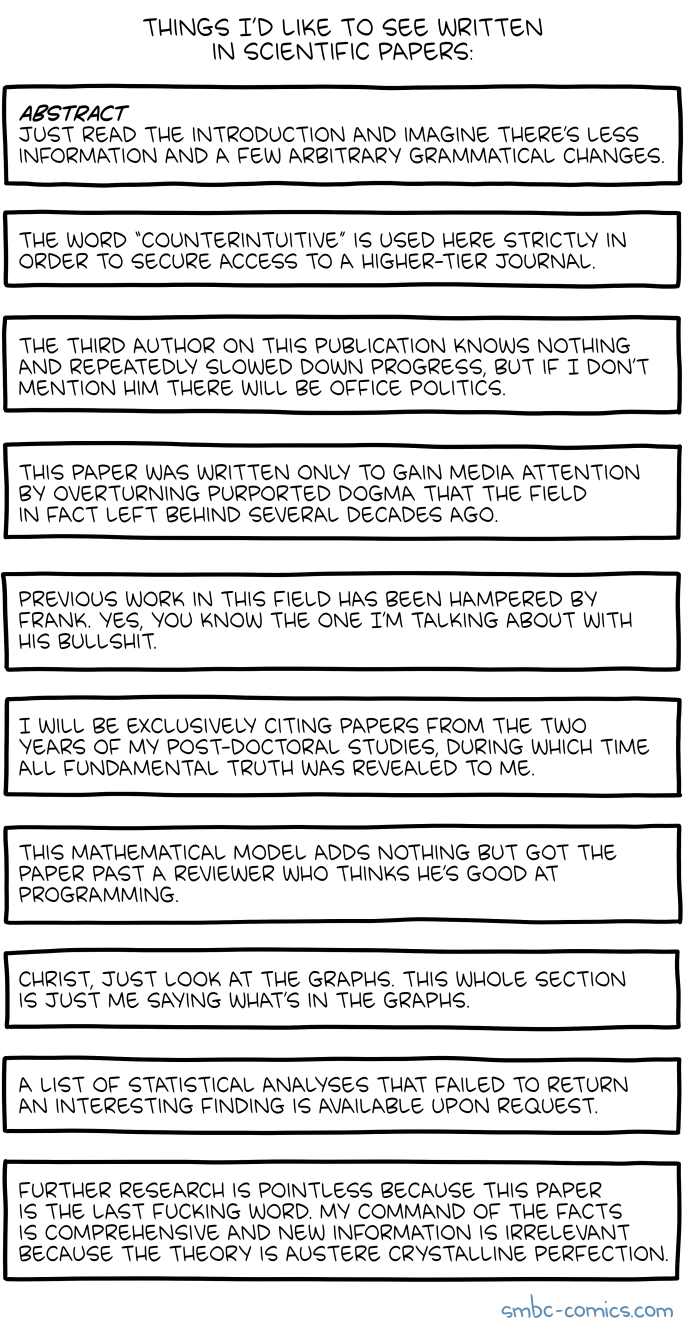
The comic is titled "Things I'd like to see written in scientific papers" and presents a list of brutally honest statements that researchers might think but would never actually write in a formal publication. These include:
- "Just read the introduction and imagine there's less floundering and a few arbitrary grammatical changes" (for the abstract)
- "The word 'counterintuitive' was used very strictly in order to acquire funding"
- "The third author on this publication has been doing nothing for years and is only there because we don't mention it"
- "This paper was written only to gain media attention"
- "Previous work in this field has been vampired by [someone you know]"
- "I will be excluding papers from the two years of my post-doctoral studies during which time I was in a deep depression"
- "This mathematical model adds nothing but got the paper past a reviewer obsessed with 'being rigorous'"
- "Christ just look at the graphs. The whole section is just the graphs written in words"
- A list of statistical analyses that failed to return interesting results
- "Further research is pointless because... the first author is a luster crystallizing dynamo" (trailing off into absurdity)
The Humor
The comic exposes the enormous gap between the polished, formal language of academic papers and the messy, human reality behind them. Every item on the list targets a well-known dysfunction in academic publishing: padding abstracts, keyword-stuffing for grants, honorary authorship, media-chasing research, mathematical theater to impress reviewers, and the suppression of null results.
The humor works because anyone who has worked in academia will recognize every single item as painfully true. The formal conventions of scientific writing serve as a kind of institutional mask, and the comic imagines what papers would look like if researchers dropped the pretense entirely.
Broader Context
SMBC's author Zach Weinersmith holds a deep familiarity with the academic world, and the comic frequently satirizes the culture of scientific research and publishing. This comic is part of a broader tradition of academic humor about the "file drawer problem" (unpublished negative results), the publish-or-perish culture, and the performative aspects of scientific writing. The comic resonates with the replication crisis discourse and ongoing debates about transparency in science.