science-communication

Explanation
The Joke
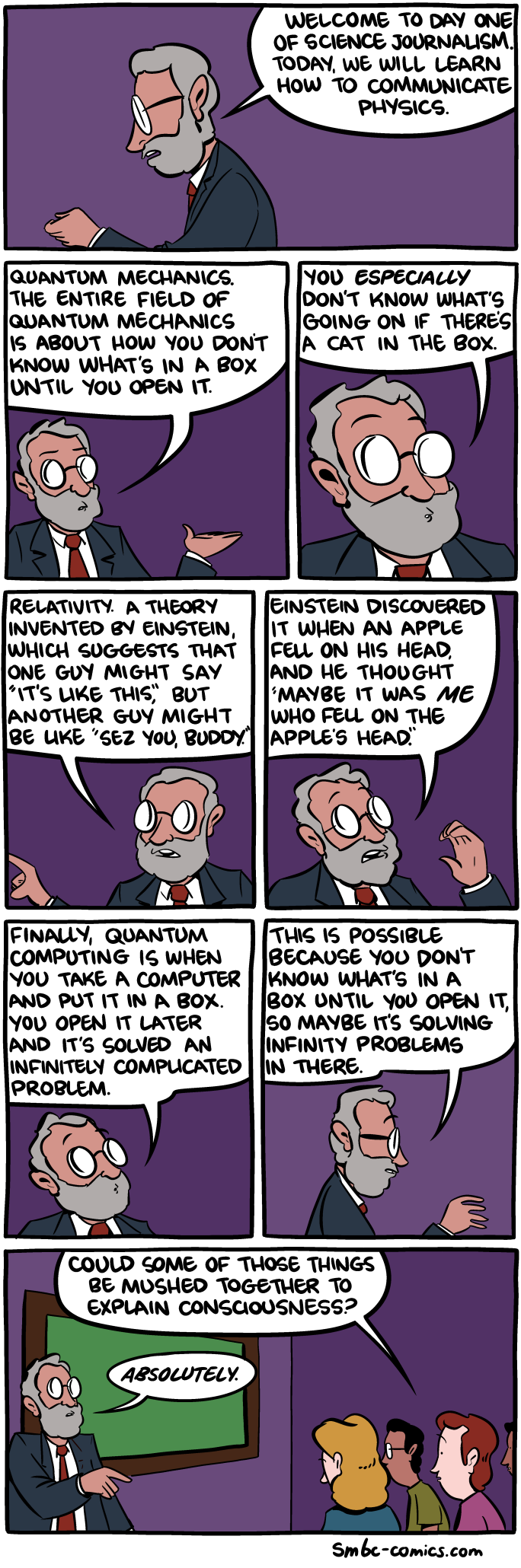
A professor stands at a chalkboard delivering "Day One of Science Journalism" to teach students "how to communicate physics." He then proceeds to give hilariously mangled explanations of several major physics concepts:
- Quantum Mechanics: "The entire field of quantum mechanics is about how you don't know what's in a box until you open it." He adds, "You especially don't know what's going on if there's a cat in the box."
- Relativity: "A theory invented by Einstein which suggests that one guy might say 'it's like this' but another guy might be like 'gez you, buddy.'"
- Einstein's discovery: He conflates Einstein with Newton, claiming "Einstein discovered it when an apple fell on his head and he thought 'maybe it was me who fell on the apple's head.'"
- Quantum Computing: "Where you take a computer and put it in a box. You open it later and it's solved an infinitely complicated problem." He then adds: "This is possible because you don't know what's in a box until you open it. So maybe it's solving infinity problems in there."
The final panel has a student asking "Could some of these be mushed together to explain consciousness?" and the professor enthusiastically responds "Absolutely!"
The Humor
The comic is a devastating satire of popular science journalism, which routinely oversimplifies complex physics to the point of complete inaccuracy. Each "explanation" takes a real concept and reduces it to a garbled, nonsensical version that sounds superficially plausible to a lay audience. The quantum mechanics explanation collapses the entire field to "boxes and cats" (a reference to Schrodinger's cat that has become the only thing most people know about quantum physics). The relativity explanation turns Einstein's framework into a mere disagreement between two guys. The quantum computing explanation is particularly sharp -- it mocks the way journalists describe quantum computers as magical problem-solving boxes. The final gag about "mushing them together to explain consciousness" skewers the trend of invoking quantum mechanics to explain consciousness, a move that physicists widely regard as nonsensical hand-waving.
References
- Schrodinger's cat is a famous thought experiment from 1935, often misrepresented in popular media as being about whether a cat is alive or dead, when it is actually about quantum superposition.
- The conflation of Einstein with Newton (the falling apple story) satirizes how popular science often blurs the contributions of different scientists.
- The "quantum consciousness" jab references thinkers like Roger Penrose and Stuart Hameroff, whose Orchestrated Objective Reduction theory attempts to link quantum mechanics to consciousness, and has been widely criticized by physicists.