Science
Explanation
The Joke
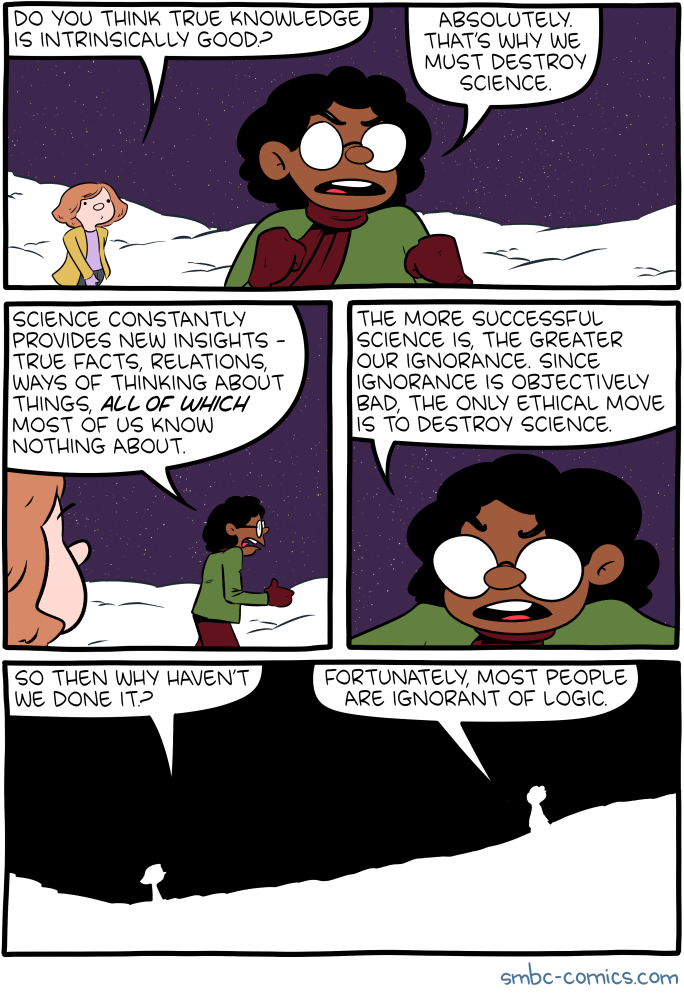
A woman asks a man whether he thinks "true knowledge is intrinsically good." He enthusiastically agrees, saying that is "the most beautiful idea in science." The woman then builds on this premise: science constantly discovers true facts and relationships, but many of these findings also reveal ways to destroy things -- potentially "all of which could destroy everything." She concludes that, given our ignorance, science is "effectively random" in what it discovers, and the only ethical move would be to destroy science itself before it stumbles upon something catastrophic.
In the third panel, the man asks why this hasn't been done already. The woman delivers the punchline: "Unfortunately, most people are ignorant of logic." This is itself a darkly ironic inversion -- the very ignorance she condemns is what saves humanity from following her argument to its nihilistic conclusion.
The Humor
The comic uses a classic SMBC technique of taking a reasonable-sounding philosophical premise and extending it through ruthless logical consistency until it reaches an absurd or horrifying conclusion. The joke works on multiple levels: first, there's the irony that a lover of knowledge is talked into concluding that knowledge must be destroyed. Second, the final punchline twists the knife by suggesting that humanity's saving grace is its stupidity -- the very thing intellectuals typically lament. The woman's argument is a parody of "galaxy-brained" reasoning, where each step seems locally valid but the conclusion is obviously insane.
References
The comic touches on existential risk philosophy, particularly arguments about information hazards and the idea that certain kinds of knowledge (e.g., how to engineer pandemics or build weapons of mass destruction) could be inherently dangerous. Thinkers like Nick Bostrom have written about the concept of a "vulnerable world" where a single discovery could be catastrophic. The comic satirizes the extreme version of this position.