self-3

Explanation
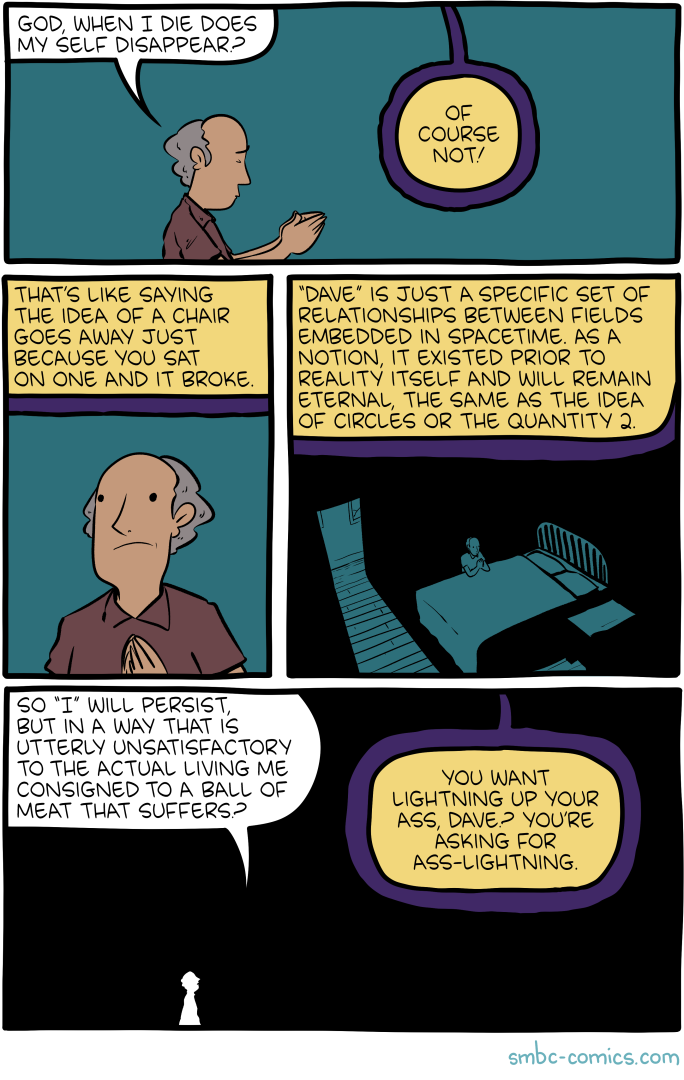
The comic explores the philosophical question of whether the "self" truly exists. In the first panel, a person asks "God, man, 2 die does myself disperse?" (a question about whether identity dissolves at death). God replies "Of course not!" but then explains that the self "is just a specific set of relationships between feelings, memories, ideas" -- that it is a notion, not a concrete thing. He compares it to how the idea of a circle or the concept of quantity existed prior to any individual human: "It existed prior to you and will remain eternal, the same as the idea of circles or the quantity 7."
In the bottom-left panel, the person processes this: "So I will persist, but it will also be literally unrecognizable, and it would be a mistake to call it 'me'?" -- essentially realizing that God is saying the abstract pattern persists but the personal, subjective experience does not. In the final panel, the person is lying in bed unable to sleep, and their partner tells them: "You want lightning up your ass, since you keep asking God ass-lightning."
The joke works on multiple levels. First, there is the classic SMBC setup of a person having a deep philosophical conversation with God, only to receive an answer that is technically comforting but existentially horrifying -- yes, "you" persist, but only in the sense that abstract mathematical concepts persist, which is not at all what anyone means when they hope for an afterlife. Second, the final panel punchline suggests this character has a pattern of pestering God with existential questions and getting punished for it (with "ass-lightning"), a recurring SMBC gag about God being petty and irritable. The humor lies in the contrast between the profound metaphysical discussion and the absurd domestic complaint at the end.