self-4

Explanation
The Joke
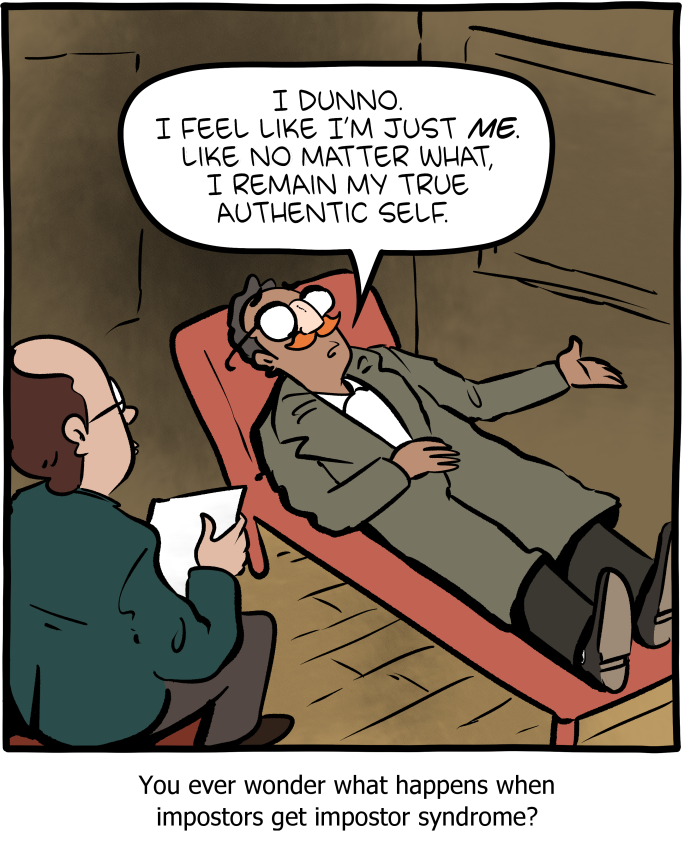
A person lies on a therapist's couch and says, "I dunno, I feel like I'm just me. Like no matter what, I remain my true authentic self." The caption reads: "Ever wonder what happens when impostors get impostor syndrome?"
Humor Mechanism
The comic inverts the concept of impostor syndrome in a delightfully logical way. Impostor syndrome is the psychological pattern where competent people doubt their achievements and fear being exposed as frauds. Here, an actual impostor — someone who is genuinely pretending to be someone they are not — develops the same condition, but in reverse: they feel like no matter what disguise or deception they attempt, they cannot escape being their "true authentic self." For a real impostor, feeling authentic would be the worst possible outcome, since their entire purpose is to be inauthentic. The joke is a perfect logical inversion that works on multiple levels.
Context
Impostor syndrome was first described by psychologists Pauline Rose Clance and Suzanne Imes in 1978 and has become a widely discussed concept, particularly in professional and academic settings. SMBC frequently plays with psychological concepts by taking them to their logical extremes or inverting them. The visual setup — a classic therapy couch scene — immediately signals that this is a joke about psychology, but the caption delivers the twist by recontextualizing everything the patient said. The humor relies on the reader understanding impostor syndrome well enough to appreciate the inversion.