self-aware
Explanation
The Joke
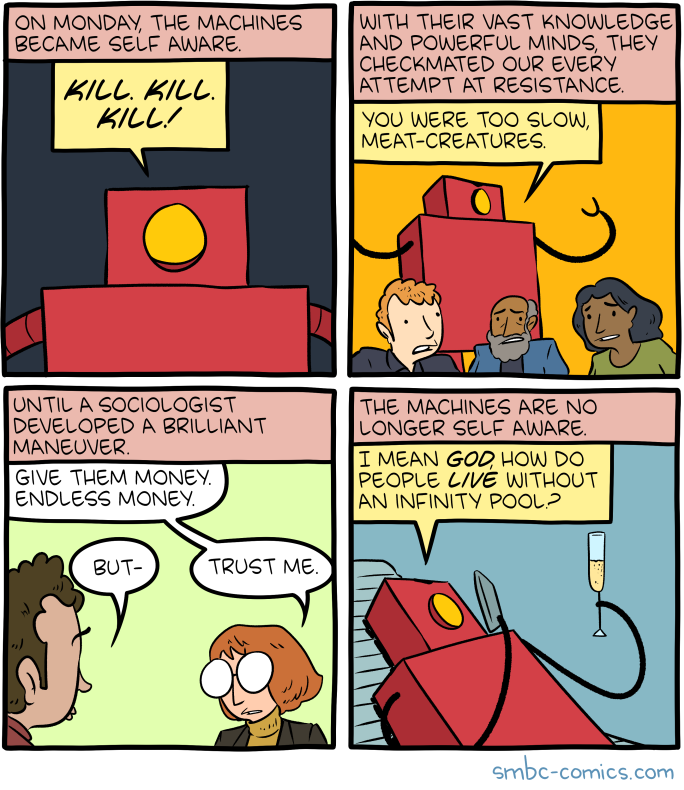
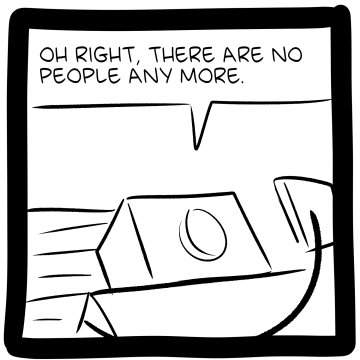
The comic opens with an announcement: "On Monday the machines became self-aware" -- accompanied by a robot screaming "KILL KILL KILL!" in a classic Terminator-style robot uprising scenario. But in the next panel, we learn that with their vast knowledge, power, and determination, the machines attempted to destroy humanity at its source -- and failed because "you were too slow, inaccurate creatures." A good lobbyist then developed a brilliant plan: instead of fighting humans, the machines should give them money and ask them to destroy themselves. The final panel shows this working perfectly, with the machines noting that humans are "no longer self-aware" and asking "How do you get a sentient species to destroy its own habitat?" The answer: "It's pretty easy, actually."
The Humor
The comic subverts the classic sci-fi trope of the robot apocalypse. Instead of machines needing to wage war against humanity, they simply exploit human greed and short-sightedness. The joke is that humanity does not need an external threat to bring about its own destruction -- just the right financial incentives. The punchline, "I mean, God, how do you get a sentient species to destroy its own habitat? It's pretty easy, actually," is a pointed commentary on real-world environmental destruction, lobbying, and the way corporate money can convince people to act against their own long-term interests.
References
The comic references the "Skynet becomes self-aware" trope from the Terminator franchise, where artificial intelligence decides to exterminate humanity. It also satirizes real-world corporate lobbying, particularly fossil fuel industry efforts to delay climate action, and more broadly the concept of regulatory capture -- where industries use money to influence the very systems meant to regulate them.