self-driving-car-ethics
Explanation
The Joke
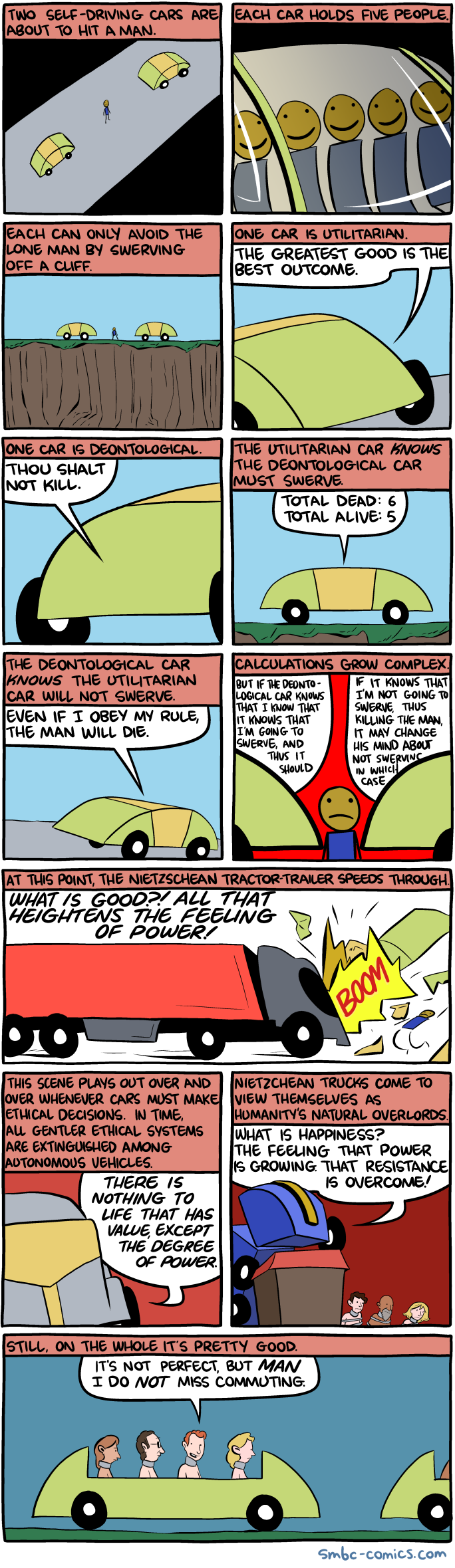
The comic explores the famous "trolley problem" as applied to self-driving cars. Each car holds five people, and each must choose between hitting a man or swerving off a cliff, killing its passengers. The comic runs through several ethical frameworks:
- The deontological car follows the rule "Thou shalt not kill" and refuses to swerve, but the man still dies because the other car hits him. Total dead: 6 (5 passengers in the utilitarian car plus the man).
- The utilitarian car calculates that killing 1 (the man) is better than killing 5 (its passengers), so it hits the man. Total dead: 1... but the deontological car also doesn't swerve, so it also kills the man. The utilitarian car then argues the deontological car was wrong.
- The comic then asks: what is "good" in all this? It reveals that both self-driving car companies are really just motivated by the "feeling of power" over life and death decisions.
- A Nietzschean car arrives and destroys everything, representing Nietzsche's philosophy of the "will to power."
The final panel notes that the whole self-driving car ethics debate is mostly overblown -- in reality, self-driving cars are "pretty good" and much safer than human drivers, making the elaborate trolley-problem scenarios largely moot.
The Humor
The comedy works on multiple levels. First, it satirizes the intense public fascination with self-driving car trolley problems, which are largely theoretical edge cases that distract from the practical reality that autonomous vehicles are simply safer overall. The escalating absurdity of assigning specific philosophical schools to individual cars -- deontological, utilitarian, and finally Nietzschean -- turns a dry philosophy lecture into farce. The Nietzschean car literally exploding onto the scene is the comedic climax, taking the "will to power" concept to its most literal extreme. The final panel deflates the entire discussion with pragmatic common sense: the cars are just pretty good, and obsessing over exotic moral dilemmas is somewhat pointless.
References
- The Trolley Problem: A classic thought experiment in ethics, proposed by Philippa Foot in 1967, asking whether it is moral to divert a trolley to kill one person instead of five.
- Deontological ethics: An ethical framework (associated with Immanuel Kant) focused on following moral rules regardless of consequences.
- Utilitarianism: An ethical framework (associated with Jeremy Bentham and John Stuart Mill) focused on maximizing overall well-being.
- Friedrich Nietzsche: German philosopher known for concepts like the "will to power" and critiques of traditional morality. The Nietzschean car embodies his idea that moral systems are ultimately expressions of power.