set-theory
Explanation
The Joke
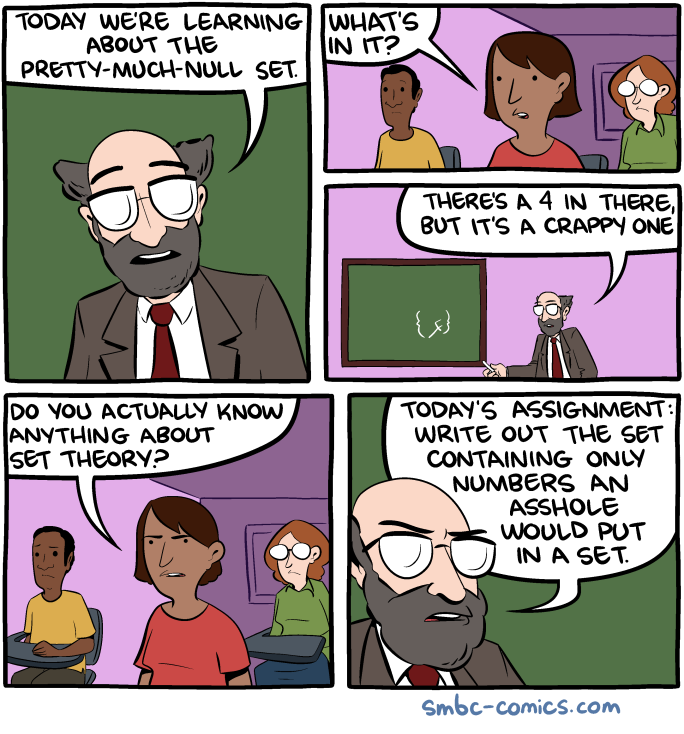
A math teacher tells the class they are learning about the "pretty-much-null set." A student asks what is in it, and the teacher says there is a 4 in there, but it is "a crappy one." The teacher asks if anyone actually knows anything about set theory. The class assignment is to "write out the set containing only numbers and letters you would put in a set."
The Humor
The comic lampoons math education by depicting a teacher who clearly has no understanding of set theory whatsoever. Real set theory is a rigorous branch of mathematics dealing with well-defined collections of objects. The "null set" (empty set) is a fundamental concept -- a set with no elements. The teacher'''s invention of a "pretty-much-null set" (a set that sort of has things in it, but bad ones) is a hilariously wrong interpretation that reveals total ignorance of the subject.
The assignment -- asking students to write a set containing "only numbers and letters you would put in a set" -- is circular and meaningless, further highlighting the teacher'''s incompetence. The humor comes from the familiar experience of being taught by someone who clearly does not understand the material, taken to an absurd extreme.
References
Set theory is a branch of mathematical logic that studies sets, which are collections of well-defined objects. It was largely developed by Georg Cantor in the late 19th century and forms the foundation of modern mathematics. The null set (or empty set, denoted as {} or the symbol with a slashed zero) is the unique set containing no elements.