shock
Explanation
The Joke
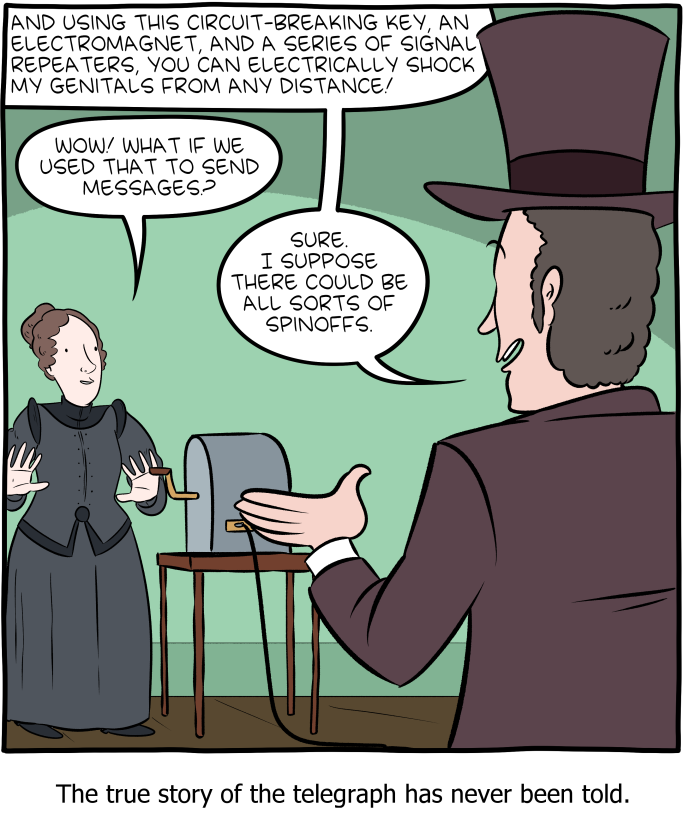
The comic depicts the supposed "true story" of the invention of the telegraph. In the first panel, an inventor (resembling a 19th-century figure, possibly meant to evoke Samuel Morse) explains his device: "By using this circuit-breaking key, an electromagnet, and a series of sound representations, you can electronically shock my genitals from any distance." His companion, a woman in Victorian dress, asks: "Wow! What if we also use it to send messages?" The inventor reluctantly concedes: "I guess the surplus capacity could be applied to all sorts of purposes."
The caption at the bottom reads: "The true story of the telegraph has never been told."
The Humor
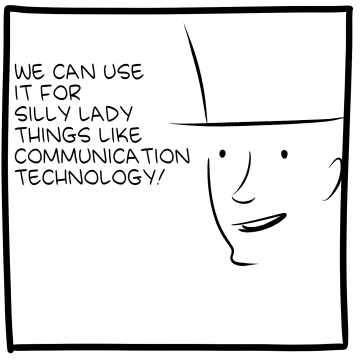
The joke plays on the recurring comedic idea that every new communication technology is secretly (or not so secretly) driven by sexual or prurient motivations. Just as the internet is often said to have been built for pornography, the comic suggests that the telegraph was originally designed as a remote sexual stimulation device, and its use for sending messages was merely an afterthought -- "surplus capacity." The Victorian setting and formal attire of the characters create a delicious contrast with the crude purpose of the invention. The inventor's reluctant acknowledgment that, yes, the device could theoretically also be used for communication perfectly captures the comic's satirical thesis about the true motivations behind technological innovation.
References
Samuel Morse developed the single-wire telegraph system and Morse code in the 1830s and 1840s. The comic parodies the well-known observation that new communication technologies tend to be rapidly adopted for sexual purposes -- from the printing press to the VCR to the internet. The "true story has never been told" framing satirizes revisionist history narratives.