should
Explanation
The Joke
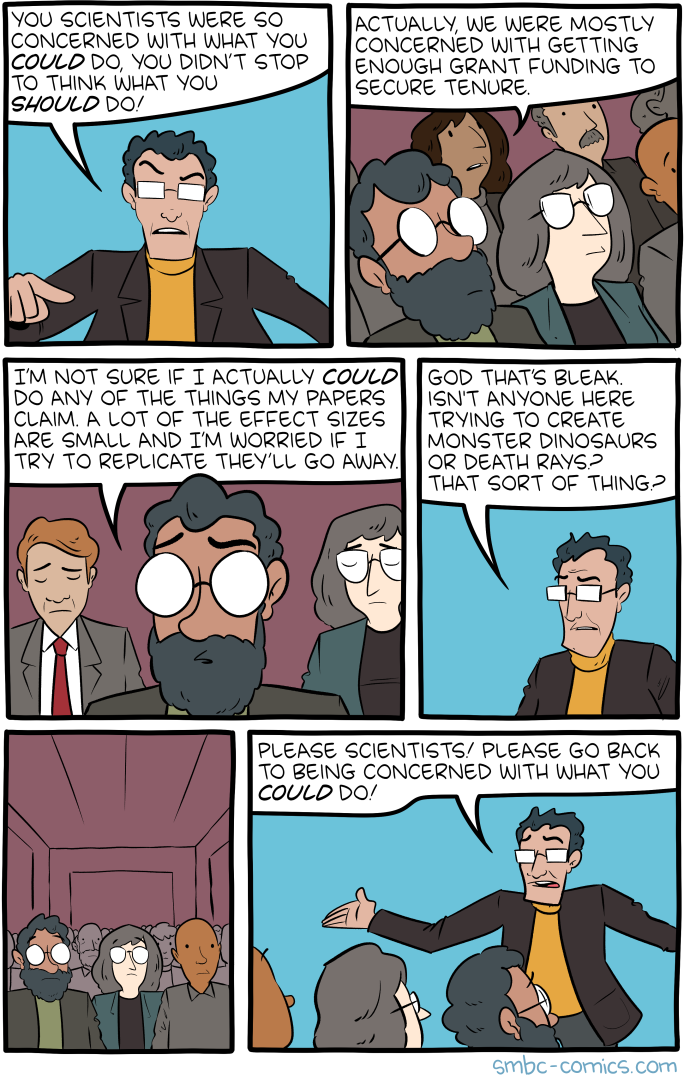
An angry member of the public confronts a group of scientists, saying "You scientists were so concerned with whether you could, you didn't stop to ask whether you should!" -- a famous paraphrase of the line from Jurassic Park. One of the scientists calmly replies, "Actually, we were mostly concerned with whether we could get enough grant funding to secure tenure."
The accuser then says they are not sure the scientists should claim a lot of their effect sizes will replicate, and the scientist responds, "Good, that's us trying to create the largest models for the widest hypothesis space possible. God, that's bleak." The person pleads: "Please, scientists, please go back to being concerned with what you could do!" -- essentially begging the scientists to return to the romantic Jurassic Park version of science where researchers are ambitious and ethically reckless, because the reality of modern academia is even more depressing.
The Humor
The comic deflates the dramatic Jurassic Park trope of scientists recklessly pushing the boundaries of knowledge by revealing that modern scientists are not boldly asking "can we?" while ignoring "should we?" -- they are mostly just worried about grant funding, tenure, and whether their results will replicate. The reversal in the final panel is the key joke: the person who came in moralizing about scientific hubris ends up begging the scientists to please go back to being dangerously ambitious, because the mundane reality of academic science -- with its replication crisis, funding anxiety, and career insecurity -- is far more dispiriting than any mad-scientist scenario.
References
The opening line is a famous misquote/paraphrase from the 1993 film Jurassic Park, where Jeff Goldblum's character Ian Malcolm says: "Your scientists were so preoccupied with whether they could, they didn't stop to think if they should." The comic also references the replication crisis in science, where many published research findings have failed to reproduce when the experiments are repeated.