Show

Explanation
The Joke
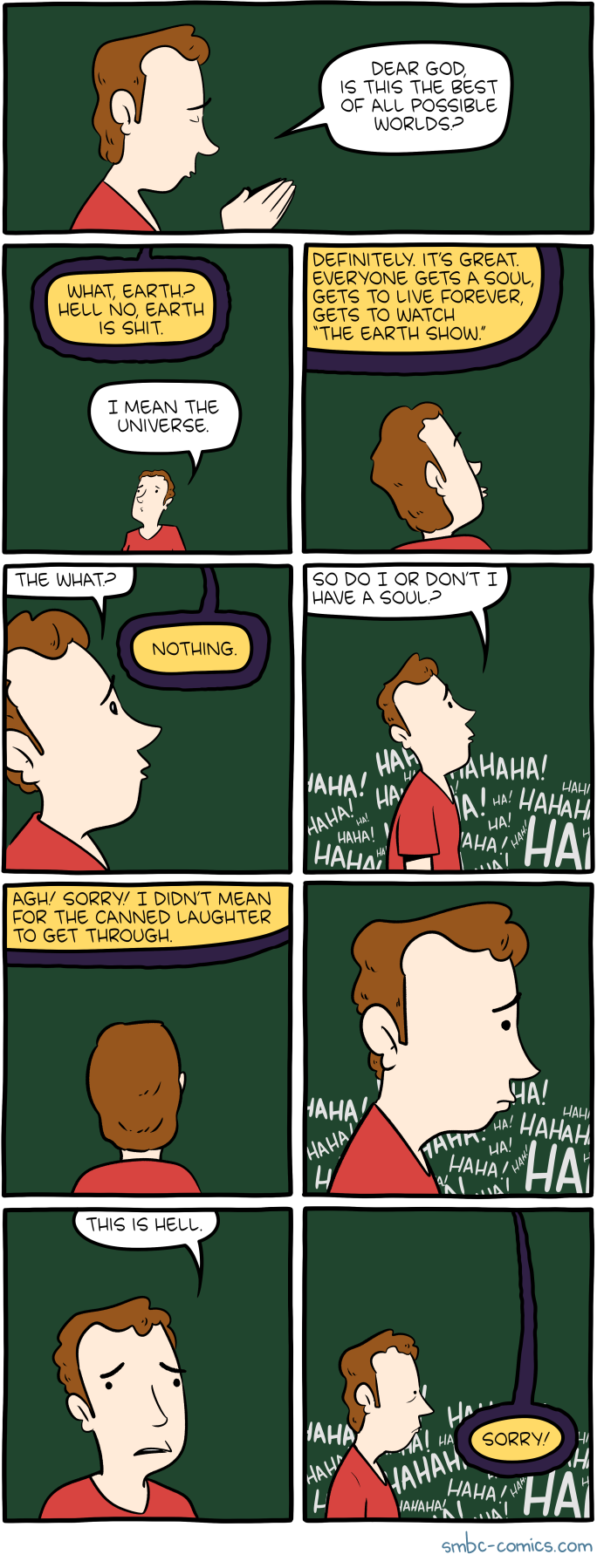
A man prays: "Dear God, is this the best of all possible worlds?" God responds: "Definitely! It's great! Everyone gets a soul, gets to watch the Earth show..." The man clarifies: "I mean the universe." God responds: "The what?" The man says: "Nothing." God then continues enthusiastically: "So do fish! Don't have a soul..." followed by laughter ("HAHAHA"). God then says: "Agh, sorry, I didn't mean for the candid laughtrack to get through!" A figure appears saying "Sure is hell-o!" and God says "Sorry!" with more laughter ("HA").
The comic presents a version of God who is essentially running Earth as a television show for an audience of souls. When the man asks about the universe (invoking Leibniz's famous philosophical question about whether this is "the best of all possible worlds"), God has no idea what "the universe" is -- implying that God only created Earth as entertainment content and the rest of the cosmos is not really part of the plan. The additional joke about fish not having souls and a candid laughtrack breaking through suggests that the afterlife is basically a cosmic comedy show with Earth as the programming.
The Humor
The humor operates on multiple levels. There is the philosophical deflation of Leibniz's grand theodicy question being answered by a God who is basically a TV producer. The reveal that fish do not have souls is treated as a joke within the show, suggesting that the afterlife audience finds the suffering and limitations of earthly creatures entertaining. The "laughtrack getting through" is a meta-joke suggesting that what we might perceive as strange or inexplicable phenomena on Earth are actually production errors from the cosmic broadcast. The whole thing is a darkly comic take on the problem of evil: suffering exists because it makes for good television.
References
The comic references Gottfried Wilhelm Leibniz's philosophical argument that we live in "the best of all possible worlds" (from his 1710 work "Theodicy"), which attempted to reconcile the existence of evil with an omnipotent, benevolent God. This argument was famously satirized by Voltaire in "Candide" (1759).