Simulation
Explanation
The Joke
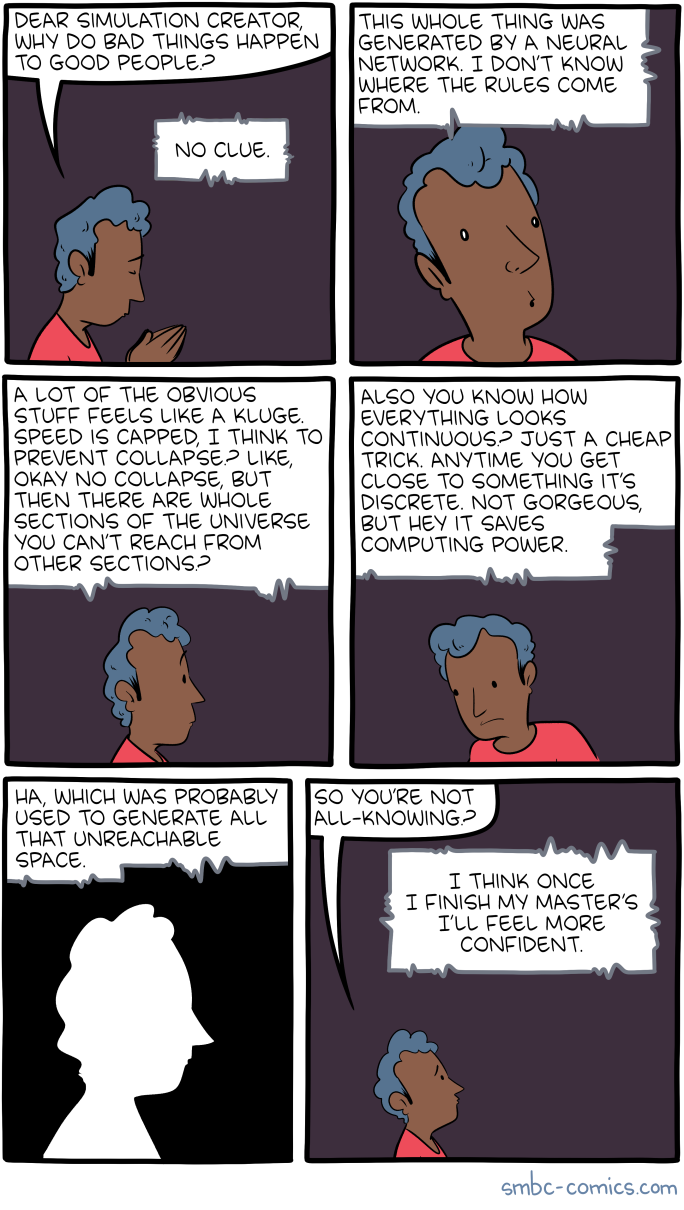
A person addresses the "Dear Simulation Creator" and asks why they wanted to make "10 billion people suffer." The creator (shown in silhouette) responds "No clue" -- they were just given the job. The person then complains that most of the universe feels like a huge empty space with clumps scattered around, and that it doesn'''t look like a well-designed simulation. The creator admits it was probably something generated cheaply: "I bet it was a cheap tool. Anyway, you get drawn to some sections of the universe but not other sections."
The conversation continues with the person asking if the creator knows how everything looks superficially fine but feels cheap and unsatisfying. The creator admits the simulation was "probably used to simulate all things." In the final panels, one character says "I think once I realized it was a simulation, I'''d feel more free" -- finding liberation in the idea. The other responds "You'''re not in a simulation" -- revealing that this entire conversation was not about an actual simulation at all, but about reality itself. The implication is that all the complaints leveled at the hypothetical simulation creator (empty universe, cheap design, suffering without purpose) are actually just descriptions of our actual universe.
The Humor
The comic is a clever bait-and-switch. The reader assumes they are reading a standard simulation hypothesis joke, but the punchline reveals that every criticism of the "simulation" is actually just a description of real life. The complaints -- that the universe is mostly empty, that things look superficial, that suffering seems purposeless -- are all legitimate observations about the actual cosmos, but they sound much more damning when framed as design failures of a lazy simulation. The humor is philosophical and darkly comic: the universe we live in is indistinguishable from a cheaply-made simulation, and the only thing missing is the comforting knowledge that someone is in charge (even incompetently). The final line about feeling "more free" if it were a simulation adds another layer -- suggesting people would actually prefer to live in a meaningless simulation than a meaningless reality, because at least a simulation implies a creator.
References
The comic engages with the simulation hypothesis, most famously articulated by philosopher Nick Bostrom in his 2003 paper "Are You Living in a Computer Simulation?" Bostrom argued that at least one of three propositions must be true: civilizations go extinct before creating simulations, civilizations choose not to run simulations, or we are almost certainly living in a simulation. The comic also touches on the problem of evil (theodicy) -- the philosophical question of why suffering exists if there is a creator -- and the fine-tuning argument in cosmology, which notes that the universe'''s physical constants seem precisely tuned for life, though most of the universe is inhospitable empty space.