simulation-5
Explanation
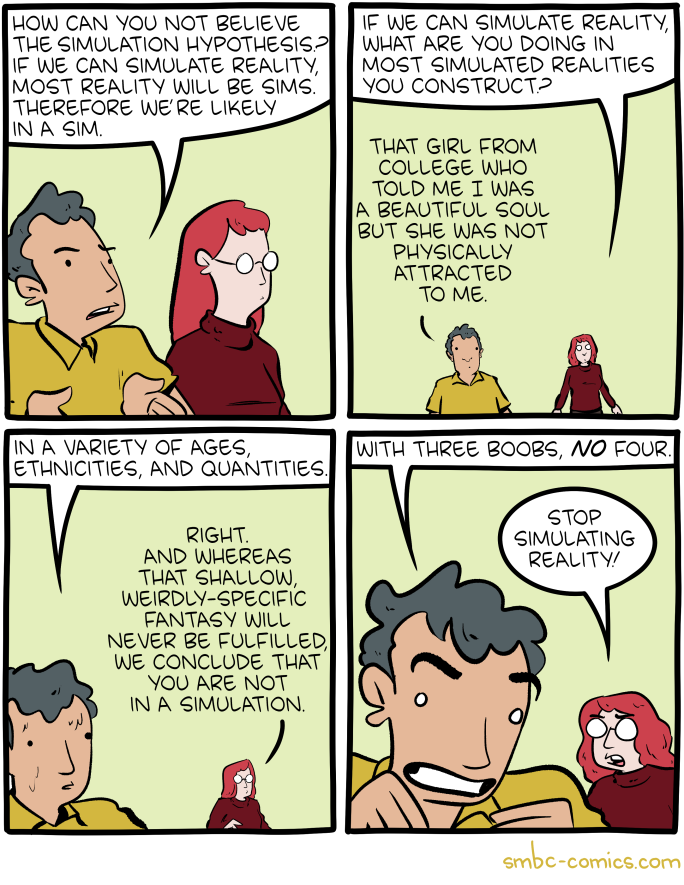
This comic riffs on the simulation hypothesis -- the idea, popularized by philosopher Nick Bostrom, that our reality might be a computer simulation run by a more advanced civilization. One character argues that if we can simulate reality, then statistically we're likely living in a simulation ourselves, since there would be far more simulated realities than "base" realities.
The twist comes through the other characters' objections. One person mentions that someone told them "I was hot, but she was not physically attracted to me" -- an apparent contradiction that they cite as evidence reality can't be a simulation, because no well-designed simulation would include something so logically incoherent. Another character adds that real human desires -- for specific ages, ethnicities, and quantities in romantic partners -- are so bizarre and particular that they could "never be fulfilled in a simulation."
The punchline arrives in the final panel, where we see two beings (the simulators) watching from outside. One says "they think those bugs are features," and the other responds "no, those ARE features" -- revealing that the bizarre, contradictory, and frustrating aspects of human romantic life that seem like evidence AGAINST a simulation were actually deliberately programmed in. The simulators intentionally made dating confusing and irrational.
The humor works by inverting the usual simulation argument. Instead of asking "is reality too perfect to be real?" the comic asks "is reality too weird and frustrating to be real?" -- and then answers that a simulator might specifically want it that way, perhaps for entertainment. It also takes a jab at the absurdity of human dating preferences and the universal experience of receiving contradictory romantic signals.