simulations
Explanation
The Joke
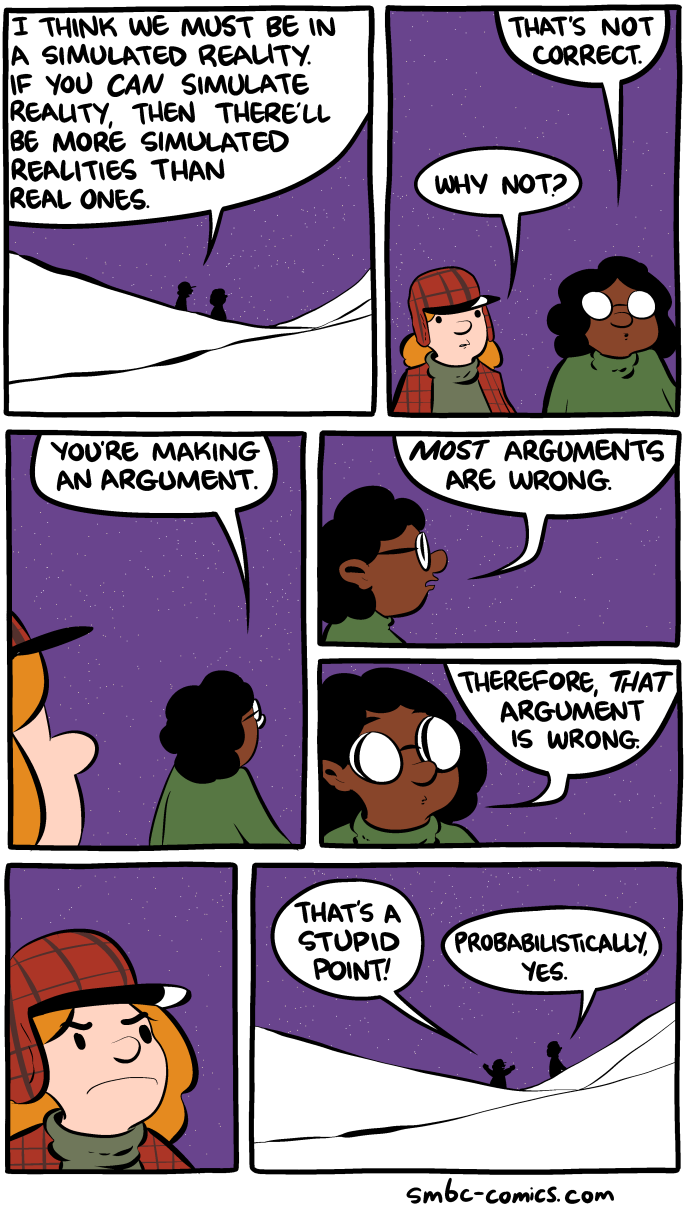
A person presents the simulation argument: "I think we must be in a simulated reality. If you can simulate reality, then there'll be more simulated realities than real ones." Their companion responds with a counter-argument that is statistically rather than philosophically grounded: "You're making an argument. Most arguments are wrong. Therefore, that argument is wrong." When the first person objects that "That's a stupid point!", the companion replies, "Probabilistically, yes."
The Humor
The comic takes aim at the simulation argument (popularized by philosopher Nick Bostrom) by applying its own probabilistic logic against itself. The simulation argument works by noting that if simulations are possible, simulated realities would vastly outnumber real ones, so we are probably in a simulation. The companion uses the same style of base-rate reasoning: most arguments people make turn out to be wrong, so any given argument is probably wrong too — including this very counter-argument (which the companion cheerfully acknowledges). The humor lies in the self-defeating circularity: the counter-argument undermines itself by its own logic, and the companion is fully aware of this but does not seem bothered. It satirizes how probabilistic reasoning, when applied too broadly and without nuance, can be used to dismiss (or support) virtually anything.
References
The simulation argument was formally articulated by philosopher Nick Bostrom in his 2003 paper "Are You Living in a Computer Simulation?" The argument proposes that at least one of three propositions must be true: civilizations almost always go extinct before developing simulation technology, advanced civilizations choose not to run simulations, or we are almost certainly living in a simulation.