skimmed
Explanation
The Joke
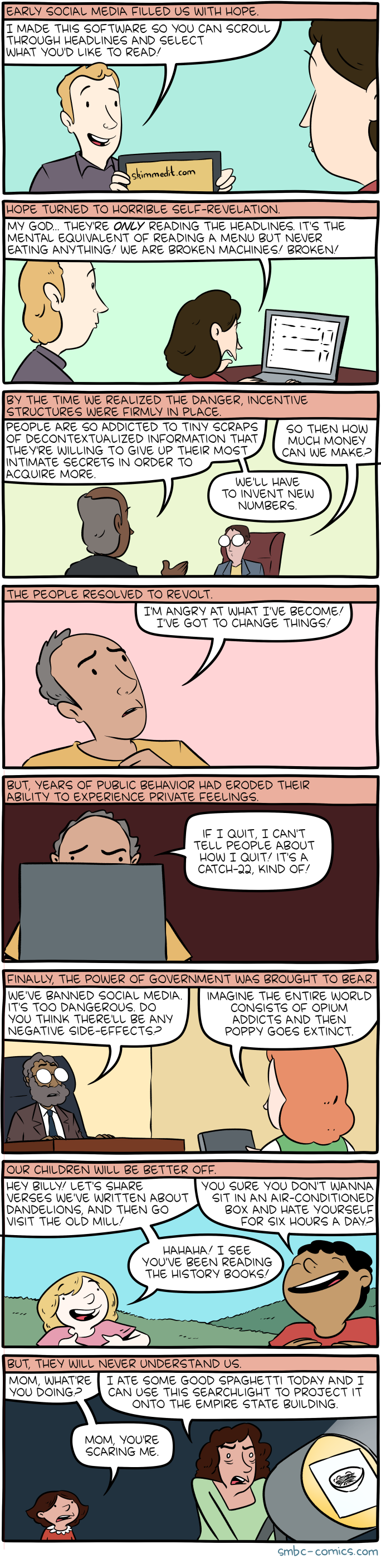
This long-form comic follows a conversation about modern media consumption and its effects. It begins with someone describing how "early social media felt so optimistic" -- platforms that let you sort through headlines and select what you want to read. But this has "turned to horrible self-devastation." A character observes that skimming headlines is "the mental equivalent of reading a menu but never eating anything. We are broken machines, broken!"
The discussion escalates as they note "the danger/incentive structure": people are so addicted to tiny scraps of information that "they're willing to give up their most valuable resource" -- time and attention -- for mere snippets. When someone suggests banning social media, another points out it is a "catch-22": quitting makes you unable to tell people how you quit. Even imagining a total ban, "the entire world would still be addicts, and then nobody goes extinct."
The comic spirals further with mentions of peer-reviewed research, a character lamenting "I'm angry at what I've become. Can I change things?" and ultimately reaching a darkly absurd conclusion involving someone wanting to "protect" something by targeting the Empire State Building, at which point someone says "Mom, you're scaring me."
The Humor
The comic is a sustained satire of the attention economy and how social media has transformed reading into a shallow, compulsive behavior. The title "Skimmed" works on multiple levels: people skim headlines rather than reading deeply, and in doing so, the richness of information is skimmed off, leaving only frothy outrage and anxiety. The escalating tone -- from mild concern to existential crisis to implied extremism -- mirrors how the doom-scrolling cycle itself escalates. The length of the comic is itself ironic: it demands sustained attention from a reader who has just been told that sustained attention is becoming impossible.
References
The comic references the broader discourse around attention economics, drawing on ideas from writers like Nicholas Carr ("The Shallows") and Tristan Harris's work on how social media platforms are designed to be addictive. The "catch-22" reference is to Joseph Heller's 1961 novel about circular, self-defeating logic.