smaug
Explanation
The Joke
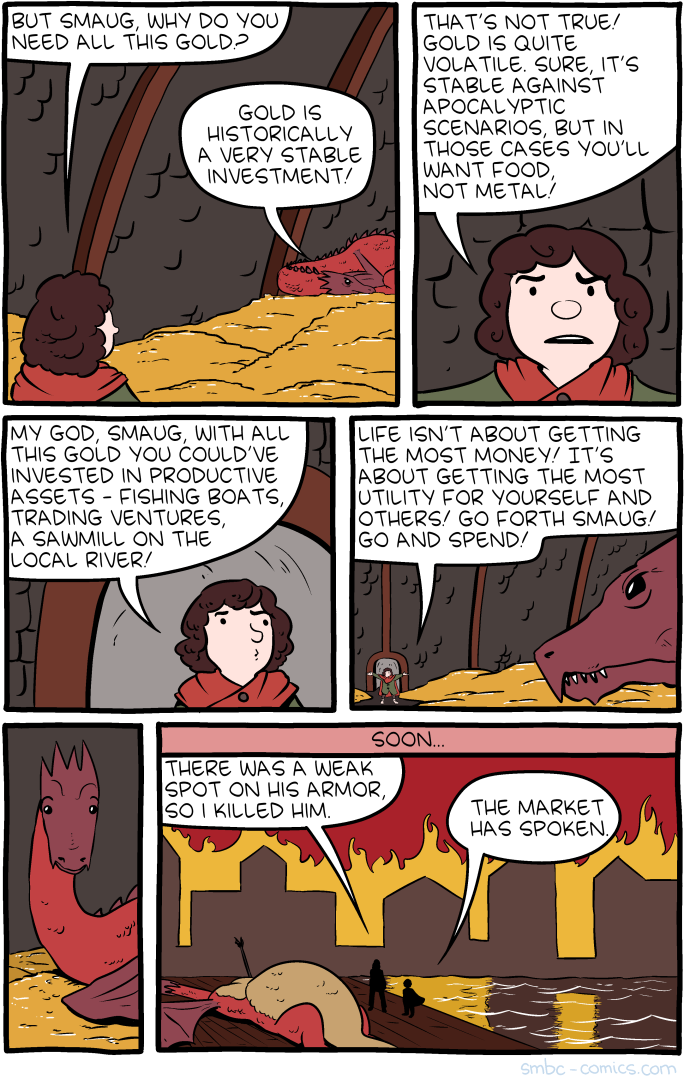
A hobbit-like character confronts Smaug the dragon about why he needs all that gold. Smaug initially claims it is a "historically stable investment," but the hobbit pushes back, pointing out that gold is only a stable store of value in certain economic scenarios and is actually a terrible hedge in others -- it's a "shiny rock," not a productive asset. The hobbit suggests Smaug should have invested his vast wealth in productive ventures, trading companies, and other enterprises that would generate returns.
Smaug is initially defensive but seems to consider the advice. The final panel reveals the aftermath: "There was a kraken on the board. I killed him." followed by "The market has spoken." This implies Smaug took the financial advice, entered the business world, and used his dragon powers to violently dominate the corporate landscape -- eliminating competitors (a kraken, representing a sea monster or perhaps a rival monopolist) through literal destruction rather than market competition.
The Humor
The comic is a parody of modern investment advice applied to Tolkien's Middle-earth. The joke works because Smaug's obsessive gold-hoarding behavior, which in the original story represents pure greed and evil, is reinterpreted as simply bad portfolio management. The hobbit sounds exactly like a condescending financial advisor telling a client to diversify. The final twist -- that Smaug enters the market and uses violence to dominate it -- is both a punchline about what happens when a dragon takes capitalism seriously and a satirical comment on how real-world corporate "competition" often involves ruthless destruction of rivals.
References
- Smaug is the dragon from J.R.R. Tolkien's "The Hobbit" who hoards a vast treasure of gold under the Lonely Mountain.
- The debate about gold as an investment (store of value vs. productive asset) is a real and ongoing argument in finance, famously critiqued by Warren Buffett, who has called gold an unproductive asset.