smile
Explanation
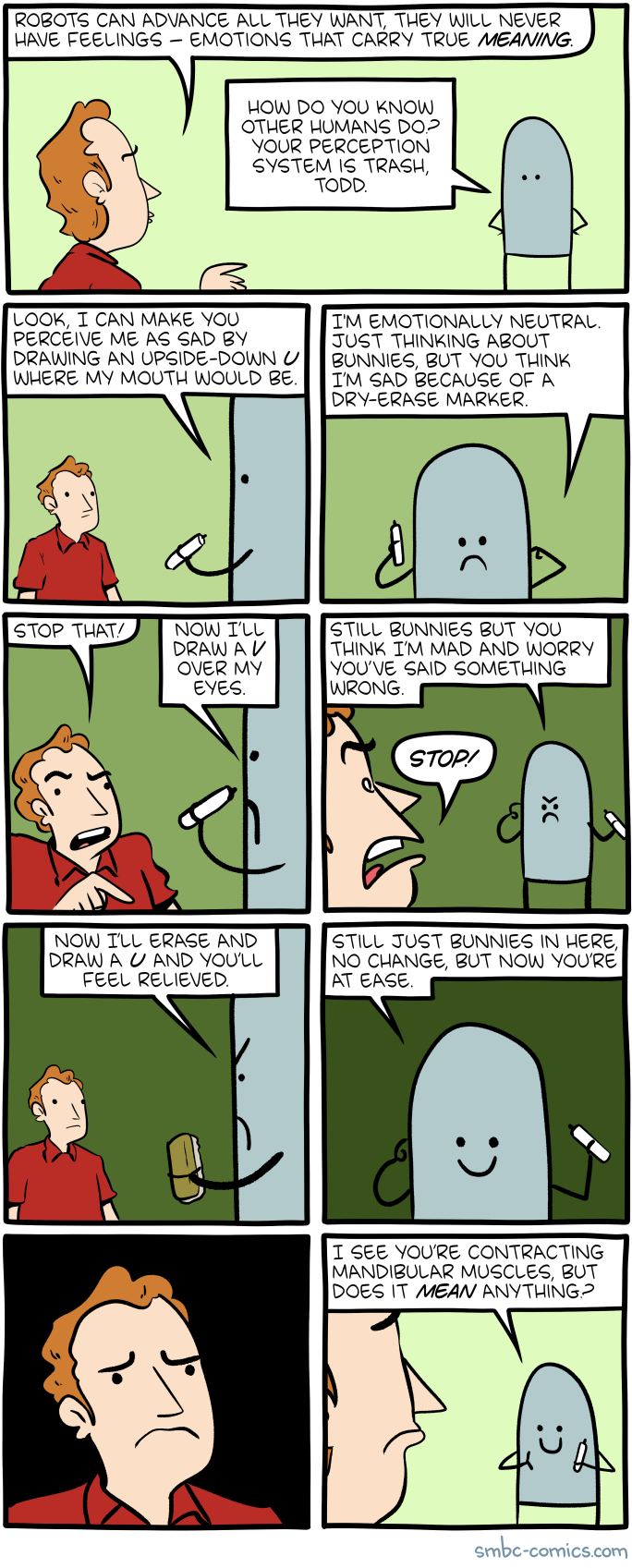
This comic explores the relationship between facial expressions and emotions, with a robot serving as the vehicle for the philosophical inquiry. In the opening panel, the premise is established: robots can advance all they want, but simulating "true meaning" in emotions like smiling remains elusive.
A human asks the robot how it knows other humans' reporting systems are genuine too, and the robot replies that it is "emotionally neutral" -- just thinking about its facial configuration and where its mouth should be. When asked to smile, the robot draws a U-shape, but it's "still borking" (not working). The robot then says it's mad and worried about being wrong, drawing increasingly distressed expressions. When told to draw a "6" shape instead, the robot reports it "feels" better but is "still borking" internally.
In the final panel, the human tells the robot that it has contracted its mandibular muscles -- but that "doesn't mean anything," which is the philosophical punchline.
The comic is a clever exploration of the philosophical problem known as the "hard problem of consciousness" and the James-Lange theory of emotion (the idea that physical expressions cause emotions rather than the other way around). It questions whether a smile has inherent emotional content or is merely a muscular configuration that we've learned to associate with happiness. The robot serves as a perfect test case because it has no preconceptions -- it can perform the physical act of smiling without any emotional substrate, raising the question of whether human smiles are fundamentally any different.