soul-9

Explanation
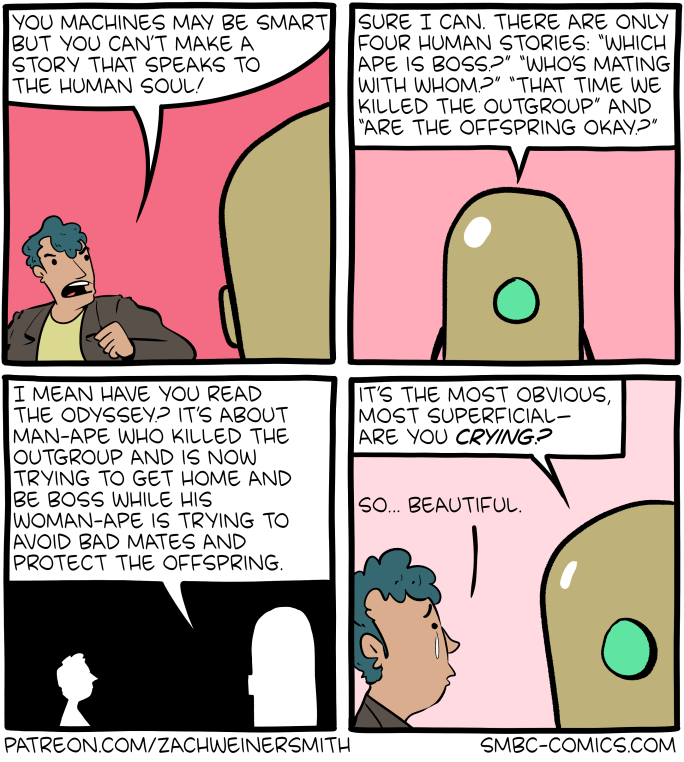
This comic features a conversation between a human and what appears to be a robot or AI, discussing whether machines can truly appreciate literature and have souls.
The human questions whether the machine can genuinely understand or appreciate great works of literature, suggesting that without a soul or true consciousness, the machine is merely pattern-matching rather than experiencing the text. The robot responds by offering a surprisingly deep and empathetic reading of Homer's Odyssey, noting that it is not just an adventure story but fundamentally about the longing to return home, the faithfulness of Penelope, and the human desire to protect what matters most.
In the final panel, the human is moved by this interpretation and says "...beautiful," suggesting that the robot's reading was not only competent but genuinely insightful -- perhaps more so than many human interpretations. The implication is that the machine's analysis demonstrated exactly the kind of emotional understanding the human claimed it could not have.
The humor is quieter than typical SMBC fare, working more as a philosophical observation than a punchline. Weinersmith is playing with the question of whether understanding and appreciation require consciousness or a "soul," and suggesting that a sufficiently sophisticated analysis might be indistinguishable from genuine feeling. There is also an ironic layer: the human who doubted the machine's capacity for appreciation ends up being the one who is emotionally affected, while the machine calmly delivers the insight. The comic subtly asks whether our criteria for "real" understanding might be more about bias than substance. It also nods at the fact that only a handful of great works of literature -- the truly canonical ones like the Odyssey -- really do speak to something universal enough that even a non-human intelligence might grasp their core meaning.