Start

Explanation
The Joke
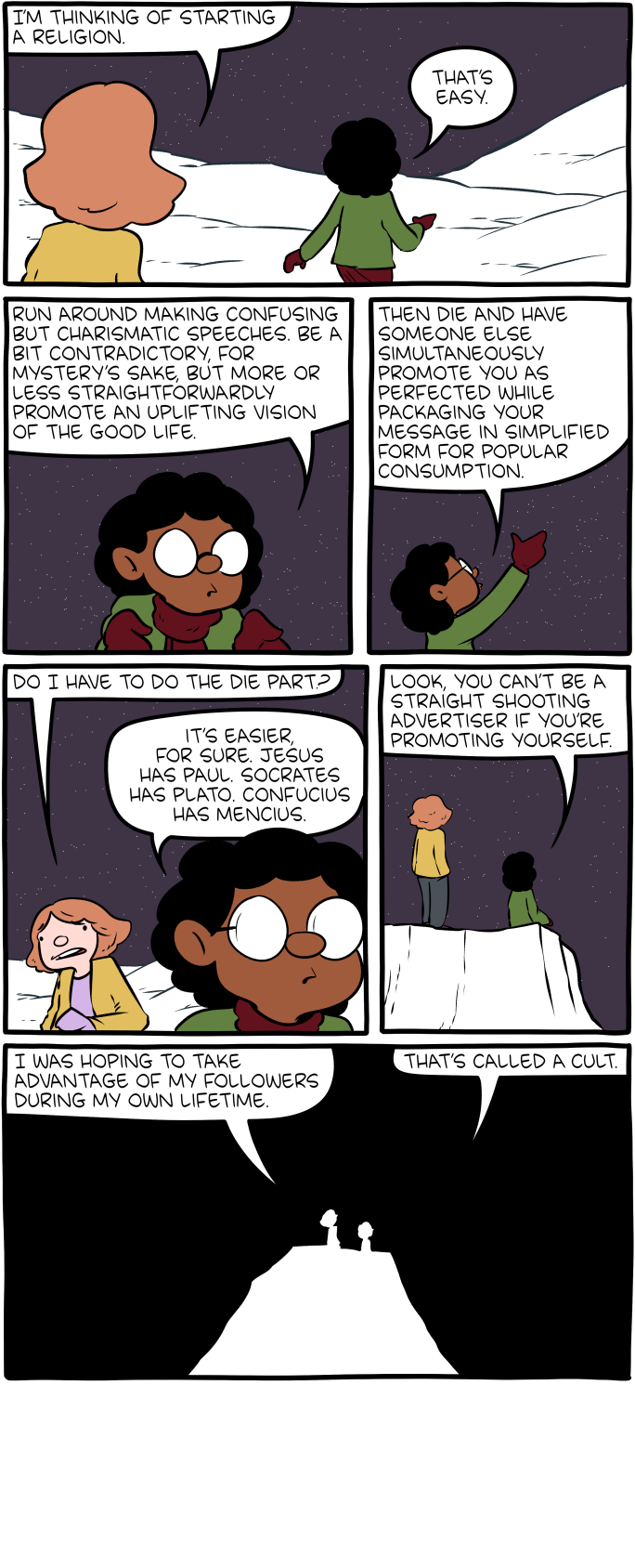
A person announces they are thinking of starting a religion. Another person says "That's easy!" The would-be founder then describes their vision: giving inspired, charismatic speeches as a spokesperson for mystery, awe, and more or less straightforward guidance on living the good life. The other person points out that they could also have someone else simultaneously repackage their message in simplified form for popular consumption -- basically making it more marketable and accessible.
The founder asks "Do I have to do the bad part?" and the other person explains that no, they don't have to -- "For sure, Jesus didn't directly promote himself. He had disciples who played simplified theological concepts." The founder then says "I was hoping to take advantage of my followers during my own lifetime." The other person responds: "That's called a cult."
The Humor
The comedy works on the tension between what a religion is versus what a cult is. The comic walks through the seemingly innocent components of starting a religion -- inspirational speeches, a message about the good life, followers who spread the word -- making it all sound reasonable. The punchline lands when the founder reveals their true motivation: personally exploiting followers while still alive. The deadpan response "That's called a cult" is both the punchline and a genuine sociological observation about the often thin line between religions and cults. The humor also plays on the idea that the mechanics of religion-building are essentially the same as cult-building; the only difference is the founder's personal greed and timeline.
References
The comic references the sociological distinction between religions and cults, which scholars have debated extensively. The mention of Jesus and disciples touches on how Christianity spread through intermediaries who simplified and popularized the original message. The comic also implicitly references various historical cult leaders who exploited their followers for personal gain during their lifetimes.