story
Explanation
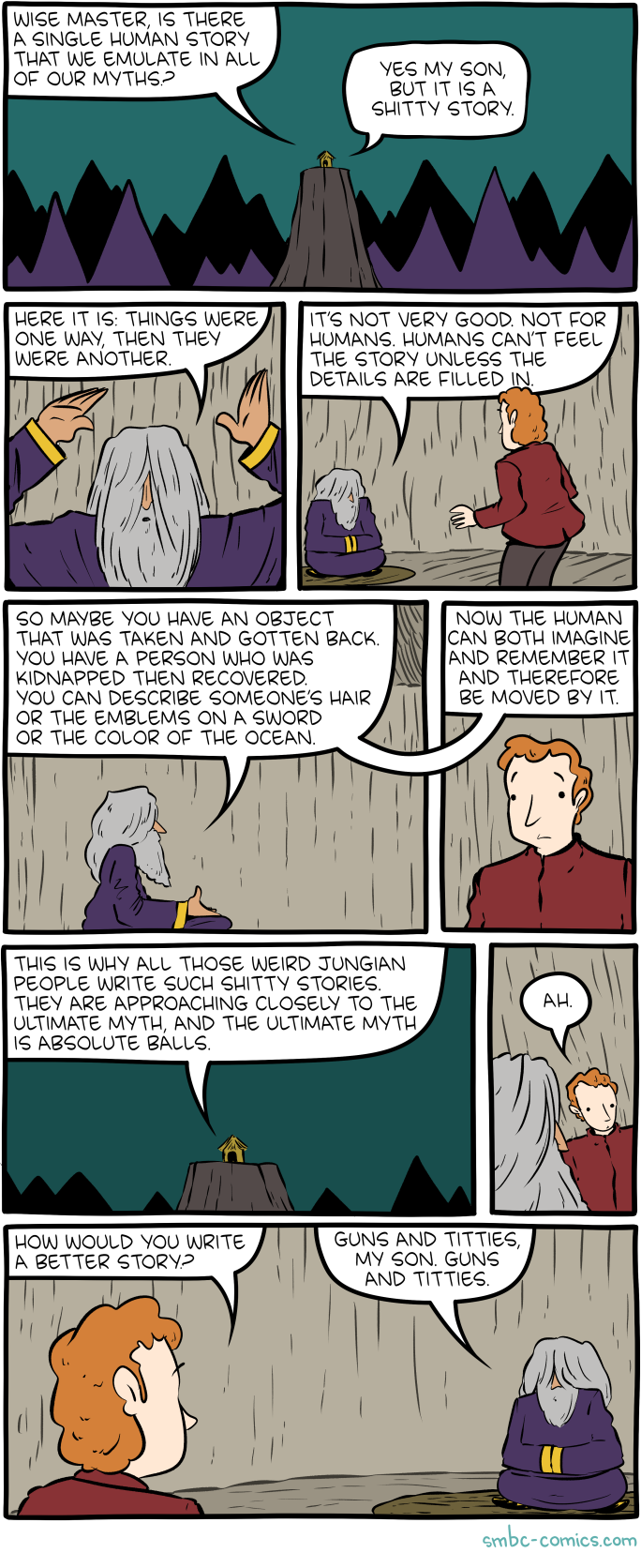
This comic features another mountaintop guru scenario, where the master is asked whether there is "a single human story that we emanate in all of our myths." The master confirms: "Yes, my son. It is a pretty story."
The master then describes the archetypal narrative structure — reminiscent of Joseph Campbell's "Hero's Journey" or Jungian archetypes — but delivered in a way that highlights how formulaic it is. You have an object that was taken, you've gotten back something precious, there's a person who was lacking something and received it. You can describe someone who has returned from a journey and can now tell of "the color of the ocean." The student is underwhelmed, noting it's "not very good" because humans can't feel anything when "the details are filled in." The master agrees that this is precisely why "all those hero Jungian people's advice about how to write good fiction is terrible" — because the universal myth and the ultimate myth are one and the same, but knowing the abstract structure doesn't help you write a compelling story.
When asked "How would you write a better story?", the master simply answers: "Guns and titties." The punchline undercuts the entire lofty discussion of mythological archetypes by suggesting that what actually engages audiences isn't deep universal themes but visceral, base-level entertainment. The comic is a critique of the over-application of Campbell's monomyth framework to storytelling, arguing that abstract mythological structures are too generic to be useful as creative writing advice, and that writers who rely on them produce bland, formulaic work.