straw-men
Explanation
The Joke
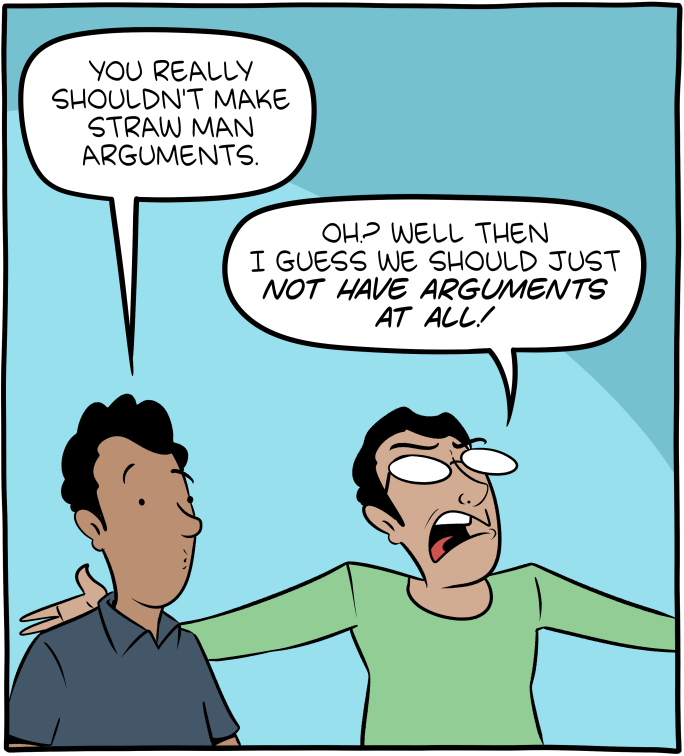
One character calmly tells another: "You really shouldn't make straw man arguments." The second character immediately responds: "Oh? Well then I guess we should just NOT have arguments at all!" This response is, itself, a textbook straw man argument — it wildly misrepresents the first person's position (which was simply "don't use straw man arguments") by exaggerating it into an extreme claim that was never made ("we should have no arguments whatsoever").
The comic is a single-panel demonstration of the very fallacy being discussed. The person accused of making straw man arguments responds to the accusation by making yet another straw man argument, proving the first person's point in real time.
The Humor
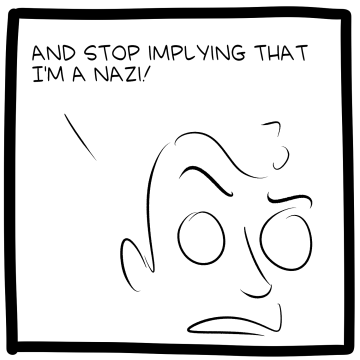
The humor is in the elegant self-referential structure. The comic does not merely explain what a straw man fallacy is — it performs one in response to being called out for it, creating a perfect loop of irony. The accused person cannot even hear the criticism without distorting it, which suggests the habit is so deeply ingrained that they are incapable of engaging with any argument honestly. The exasperated expression on the first character's face completes the joke, conveying the futility of trying to reason with someone who reflexively strawmans every position. It is a concise, almost mathematical joke — the kind of logical humor Weiner excels at.
References
A straw man argument is an informal logical fallacy in which someone misrepresents an opponent's position — typically by exaggerating, oversimplifying, or completely fabricating it — in order to make it easier to attack. The term dates back to at least the early 20th century in its current usage and is one of the most commonly discussed logical fallacies in rhetoric and critical thinking.